Report on Undergraduate Teaching Quality of JXUT in 2019-2020 Academic Year
University profile
Jiangxi University of Technology (JXUT) is a full-time private ordinary undergraduate University with engineering, management and art as the main subjects and coordinated development of multi disciplines. It is one of the first two pilot universities with comprehensive education reform in Jiangxi Province. China holds high the great banner of socialism with Chinese characteristics and guided by Xi Jinping's socialist ideology with China's characteristics in the new era. JXUT fully implements the party's educational policy in line with the needs of the country and Jiangxi's economic and social development combining with its own reality, sticks to the road of applied undergraduate education development, and focuses on educating high-quality applied students with expertise and innovative ability.
The University is located in Nanchang, a famous historical and cultural city in the south of the Yangtze River and the capital city of Jiangxi Province. Founded in 2005, the University has 46 undergraduate majors, of which 17 are new majors. The University has 11 secondary colleges including the School of Intelligent Engineering and the Department of Ideological and Political Teaching. It has a digital library with a collection of nearly 2.47 million books, covering 33,000 square meters; There are a plastic track and field, a gymnasium, a theater and some other student activity places; There are more than 230 laboratories in the University, such as Automobile Technology Center, with advanced experimental equipment; The campus network, with 10 Gigabit supplied to the core network, 1 Gigabit to buildings’ network, and 100mbps to the individual desktop, in order to fully cover the campus with wireless network. The University has 32,285 full-time students and 2,040 teaching staff, including 1,572 full-time teachers.
Programme structure and layout are set up according to actual needs of the society. JXUT has formulated Measures for Programme Setting and Dynamic Adjustment to further clarify the closure of some majors with low application rate, poor employment rate and insufficient experimental conditions, and the closure of undergraduate enrollment for Mechanical Engineering and Internet of Things Engineering. At the same time, JXUT actively responds to the requirements of developing new economy and fostering new growth drivers in Jiangxi. In 2020, the University applied to the Ministry of Education of China for five undergraduate majors, including Intelligent Manufacturing Engineering, Block Chain Engineering, Big Data Management and Application, Urban and Rural Planning, and Film and Television Photography and Production. It has basically formed a programme structure system in which the number of majors fits with the number of enrolled students, the setting of majors fits with the needs of society, the structure of majors fits with the development of disciplines and the education objective fits with the level of the University. JXUT has launched the 14th Five Year Plan discipline development scheme, which studies and demonstrates the development direction and development goals of each major of JXUT. At present, the University has one provincial first-class major and 3 majors selected in the 2.0 Plan of the Excellent Engineer Education and Training.
At the end of 2018, the University went through the Higher Education Review of Undergraduate Institutions conducted by Ministry of Education and was highly praised by the Panel. As quoted from the address by the Panel, “JXUT has achieved remarkable results in actively exploring the development path of private colleges and universities. The reputation of the University, the satisfaction of students and the recognition of the society are constantly improving. The University has been ranked first in the competitiveness of private colleges and universities in China for many years, and is at the top of the list of major private colleges and universities.”
JXUT plays an essential role among private colleges and universities in Jiangxi Province, and it is a pioneer of higher education in Jiangxi Province. Mr. Yu Guo, the founder of the University, is a deputy to the Ninth, Tenth and Eleventh National People's Congress and a member of the Standing Committee of the 12th and 13th Jiangxi Provincial People's Congress, he has been cordially received by Party and national leaders for many times.
Since its establishment in 1994, the University has always adhered to the principle of "rejuvenating the country through science and education, and running a University for the revitalization of China", abided by the motto of "self-improvement, truth-seeking and pragmatism", practiced the academic atmosphere of "happy learning, good thinking, and unity of knowledge and practice", inherited the JXUT spirit of "self-confidence, self-improvement, entrepreneurship and innovation", and focused on cultivating students' comprehensive ability, self-improvement, entrepreneurship and innovation with professional ability and innovation ability, more than 200,000 applied students have been trained for the society, and the University running strength and influence have been continuously enhanced. For many years, it has been at the top of the list of China's private universities and has become one of the leaders of private universities in Jiangxi Province.
· Basic situation of undergraduate education
According to the needs of national and local economic and social development and its own characteristics, the University specifies its development direction and the goal of student education. Centering on the goal of educating high-quality applied graduates, the University scientifically develops the programme in order to continuously improve the quality of students.
1.1 Student education objectives and service orientation
JXUT holds high the great banner of socialism with Chinese characteristics and guided by Xi Jinping's socialist ideology with China's characteristics in the new era. It fully implements the party's educational policy and in line with the needs of the country and Jiangxi's economic and social development, and combining with its own strengths, sticks to the road of applied undergraduate education development, and focuses on cultivating high-quality applied students with expertise and innovative ability.
The orientation of University running type: application oriented local private undergraduate colleges and universities;
The orientation of University running level: the general undergraduate education should be given priority to, the higher vocational education should be given consideration to, and the professional postgraduate education should be developed timely;
The orientation of programme development: to give priority to engineering, management and art, and coordinate the development of other disciplines;
The orientation of talent training objectives: to cultivate high-quality applied students with expertise and certain innovation ability to meet the needs of economic and social development, facing the front line of production, management and service;
The service orientation: serving the front line and local economic and social development of Jiangxi and whole country;
The goal of running a University is to serve the local economic and social development, meet the needs of industries and enterprises, and be a leading application-oriented private undergraduate University with distinctive characteristics in China.
1.2 Undergraduate programme setting
The University follows the teaching law of higher education, centers on the goal of cultivating high-quality applied students with expertise and specific innovation ability to meet the needs of social and economic development, takes the social demand as the guidance, constantly optimizes the professional structure, and forms a discipline layout with engineering, management and art as the main subjects and coordinated development of other disciplines.
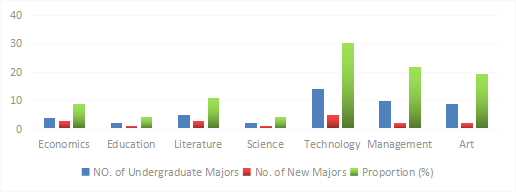
The University has 46 undergraduate majors, including 17 new programmes, 1 provincial first-class major, and 3 majors selected in the excellent engineer education and training plan 2.0. At present, there are 14 engineering majors, accounting for 30.43%; 10 Management majors, accounting for 21.74%; 9 Arts majors, accounting for 19.57%; 5 Literature majors, accounting for 10.87%; 4 Economics majors, accounting for 8.70%; one Medical Science major, accounting for 2.27%, and; One Education major, accounting for 2.27%. The layout of disciplines is shown in Figure 1-1.
Figure 1-1 Distribution of Disciplines
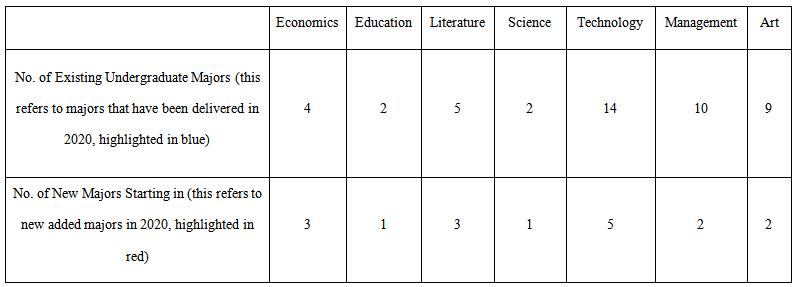
Notes:
1.The number of new added majors are included in that of existing majors.
2.The proportion shown in green refers to that of the number of existing majors in the total number of majors.
1.3 Students scale on campus
There are 32,285 full-time students, including 20,334 undergraduates (accounting for 62.98%), 11,611 junior college students, 311 international students and 29 general preparatory students. The breakdown of full-time students is shown in Figure 1-2.
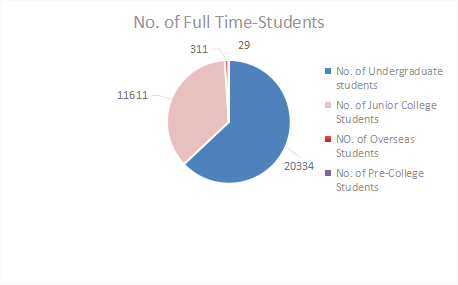
Figure 1-2 Full Time Students
1.4 Quality of undergraduate students
In 2020, the University has recruited 6,561 students. The University has constantly adjusted the structure of student sources. According to the general undergraduate education and the orientation of higher vocational education, the number of undergraduate students has been increasing year by year, and the proportion of undergraduate students has been continuously optimized. At present, the proportion of undergraduate students accounts for 62.98% of the total number of full-time students.
With the development of education quality and the improvement of university running ability, the influence of the University is further expanded. More candidates are eager to apply for JXUT. In 2020, it will recruit students from 30
provinces (cities, autonomous regions) in China. On the whole, the quality of students increased steadily. The condition of students is shown in Table 1-1 (excluding art enrollment).
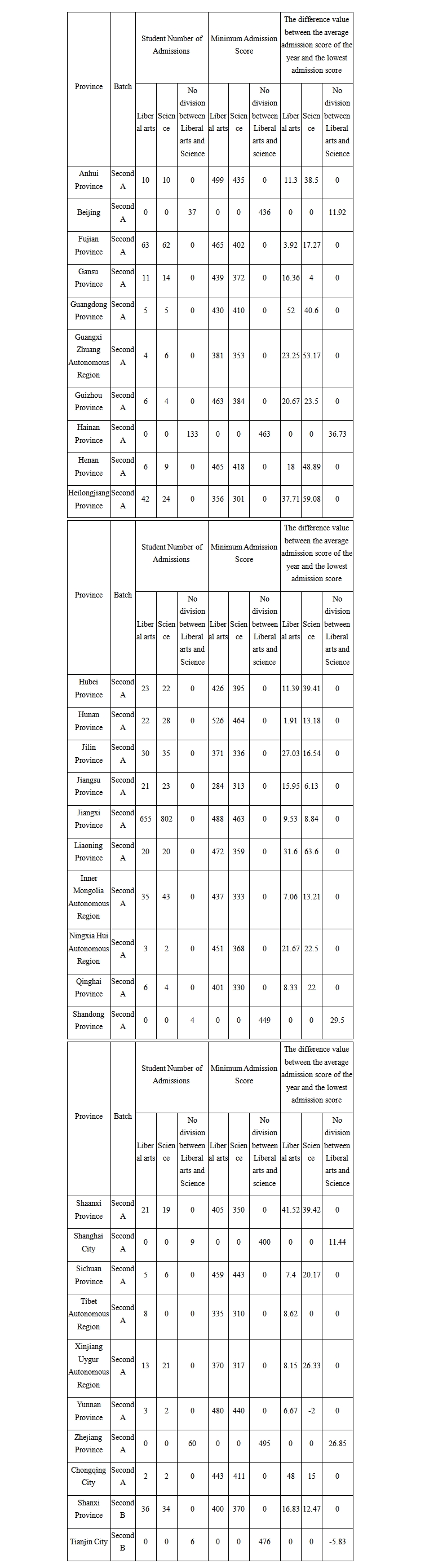
Table 1-1 the Condition of Undergraduate Students
2. Teachers and teaching conditions
The University adheres to the strategy of "improving the University with talents", focuses on the development of teaching staff, follows the idea of developing both quantity and quality as well as theoretical level and practical ability by introducing and developing teachers, and focuses on the introducing of high-level talents, and development of backbone talents and young teachers, so as to initially form a teaching staff with moderate scale, reasonable structure, excellent quality and student's satisfaction, it provides sufficient guarantee for undergraduate teaching and applied talents training; The University guarantees the steady growth of teaching investment, promotes the continuous improvement of teaching conditions, and all kinds of teaching resources can well meet the needs of teachers and students, so as to ensure the improvement of undergraduate teaching quality and the realization of talent training objectives.
2.1 Number and structure of teaching staff
2.1.1. The Number of Teaching Staff Meets the Needs of Teaching
In order to ensure the smooth progress of undergraduate teaching and improve the quality of personnel training, the University attaches great importance to the development of teaching staff. The University continues to promote the "four talent projects" (young teachers with master degree project, young and middle-aged backbone teacher training project, high-level talent introducing project, and "double quality" teacher training project). Through induction and training, the number of teachers has increased year by year, and the quality of teachers has been continuously improved. A team of teachers of moderate scale, organised structure, excellent quality and student's satisfaction has basically formed. At present, the University has 1,572 full-time teachers and 405 part-time teachers. According to the number of 32,285 students, the existing student teacher ratio is 18.19:1, which can meet the existing teaching needs. The number of teachers in the past two academic years is shown in table 2-1.
Table 2-1 Number of Teachers in Recent Two Academic Years
Academic year |
Number of full time teachers |
Number of part-time teachers |
Equivalent to the total number of teachers |
Student-teacher ratio |
2019-2020 |
1,572 |
405 |
1,774.5 |
18.19 |
2018-2019 |
1,392 |
459 |
1621.5 |
18.26 |
2.1.2. The organised structure of teaching staff
At present, there are 480 full-time teachers with senior professional titles, accounting for 30.53% of full-time teachers; There are 1,218 teachers with master's degree and doctor's degree, accounting for 77.49% of full-time teachers. In terms of age structure, there are 623 teachers under 35 years old, accounting for 39.63%, 655 teachers between 36 and 45 years old, accounting for 41.67%, 198 teachers between 46 and 55 years old, accounting for 12.60%, and 96 teachers over 56 years old, accounting for 6.11%. The structure of teacher's titles, degrees and ages are shown in table 2-2.
Table 2-2 Structure of Professional Title, Degree and the Age of Teachers
Project |
Full Time Teacher |
Part-time Teachers |
Number |
Proportion (%) |
Number |
Proportion (%) |
Total |
1572 |
/ |
405 |
/ |
Title |
Professor |
67 |
4.26 |
50 |
12.35 |
Associate Professor |
300 |
19.08 |
90 |
22.22 |
Lecturer |
572 |
36.39 |
98 |
24.2 |
Assistant Lecturer |
264 |
16.79 |
20 |
4.94 |
Other senior |
21 |
1.34 |
20 |
4.94 |
Other deputy senior |
92 |
5.85 |
61 |
15.06 |
Other intermediate |
54 |
3.44 |
26 |
6.42 |
Other elementary |
12 |
0.76 |
0 |
0 |
Unrated |
190 |
12.09 |
40 |
9.88 |
Highest Degree |
Doctor |
151 |
9.61 |
118 |
29.14 |
Master |
1067 |
67.88 |
153 |
37.78 |
Bachelor |
244 |
15.52 |
60 |
14.81 |
No degree |
110 |
7.00 |
74 |
18.27 |
Age |
Under 35 Years Old |
623 |
39.63 |
53 |
13.09 |
36-45 Years Old |
655 |
41.67 |
162 |
40.00 |
46-55 Years Old |
198 |
12.6 |
125 |
30.86 |
56 Years Old and Above |
96 |
6.11 |
65 |
16.05 |
Learning-Origin |
This University |
19 |
1.21 |
0 |
0 |
Outside This University |
Domestic |
1502 |
95.55 |
0 |
0 |
Abroad |
51 |
3.24 |
0 |
0 |
2.1.3. Pay attention to optimize the allocation of "double qualified" teachers and teachers for practical teaching
According to the orientation of "application-oriented local private undergraduate colleges", the University promotes the development of "double qualification" teachers by relying on University enterprise cooperation units and sending teachers to enterprises for practice, and strives to improve the level of teacher's practical teaching and applied talents training. It has formed a team of double qualified teachers with reasonable quantity structure, rich practical experience in teaching and guidance, full-time and part-time, and the combination of inside and outside the University, which provides strong support for the teaching and research work and the cultivation of applied students. At the same time, the experimental teachers are encouraged to improve the development of the experimental technology teachers team through the promotion of educational background, further training and post adjustment, so as to meet the needs of practical teaching and applied talents training in Application-oriented colleges and universities.
At present, there are 675 double qualified teachers, accounting for 42.94% of full-time teachers, including 43 senior teachers and 224 deputy senior teachers. The number of teachers with senior titles accounts for 39.56% of the total number of full-time teachers; There are 536 teachers with master's and doctoral degrees, accounting for 79.40% of the "double qualified" teachers. The number of "double qualified" teachers is 50 more than that of last academic year, and the quality of teachers is also improving year by year “See table 2-3 and table 2-4 for the details of "double qualification" teachers.
Table 2-3 Structure of "Double Qualified" Teachers
Academic Degree |
Senior |
Deputy Senior |
Other |
Total |
Proportion |
Doctor |
10 |
29 |
13 |
52 |
7.70% |
Master |
18 |
155 |
311 |
484 |
71.70% |
Bachelor |
13 |
22 |
48 |
83 |
12.30% |
No degree |
2 |
18 |
36 |
56 |
8.30% |
Total |
43 |
224 |
408 |
675 |
100.00% |
Proportion |
6.37% |
33.19% |
60.44% |
100.00% |
\ |
Table 2-4 Structure of Teachers for Practical Teaching
Academic Degree |
Senior |
Deputy Senior |
Other |
Total |
Proportion |
Master |
5 |
3 |
7 |
15 |
12.50% |
Bachelor |
3 |
8 |
50 |
61 |
50.83% |
No degree |
5 |
5 |
34 |
44 |
36.67% |
Total |
13 |
16 |
91 |
120 |
100.00% |
Proportion |
10.83% |
13.33% |
75.83% |
100.00% |
\ |
2.2 Teachers for undergraduates
In terms of the structure of lecturers, professors are the main body, associate professors and lecturers are the main body, so as to ensure the quality of undergraduate course teaching and the demand of undergraduate ability training.
The number of courses undertaken by teachers with senior titles in this academic year is 525, accounting for 44.38% of the total number of courses; there are 1,504 courses this year, accounting for 29.43% of the total courses, which is higher than that of last academic year.
The number of courses undertaken by professors (excluding other senior teachers) is 87, accounting for 7.35% of the total courses; The number of courses was 146, accounting for 2.86% of the total courses; The number of courses undertaken by associate professors is 438, accounting for 37.02% of the total number of courses; The number of courses was 1,358, accounting for 26.58% of the total courses.
There are 82 professors in the University, 63 of whom are responsible for undergraduate teaching, and 76.82% of total courses are them are professors; There are 308 teachers with the title of associate professor, 292 of whom are responsible for undergraduate teaching, and 94.81% of them are teaching undergraduate courses. At the same time, the University introduced 2 academicians of Chinese Academy of Engineering, 2 national high-level talents and 9 provincial high-level talents. The teaching situation of professors and associate professors is shown in table 2-5.
Table 2-5 teaching situation of professors and associate professors
Category |
Total number of People |
Project |
Number of Teachers |
Percentage (%) |
Courses (courses) |
Percentage (%) |
Number of courses |
Percentage (%) |
University |
/ |
/ |
5110 |
/ |
1183 |
/ |
Professor |
82 |
Teaching Professor |
63 |
76.83 |
146 |
2.86 |
87 |
7.35 |
Public required course Compulsory Courses |
10 |
12.20 |
16 |
0.31 |
8 |
0.68 |
Public Elective Courses |
0 |
0.00 |
0 |
0.00 |
0 |
0.00 |
Professional Courses |
56 |
68.29 |
130 |
2.54 |
80 |
6.76 |
Associate Professor |
308 |
Teaching Associate Professor |
292 |
94.81 |
1358 |
26.58 |
438 |
37.02 |
Including: Public Compulsory Courses |
70 |
22.73 |
526 |
10.29 |
57 |
4.82 |
Public Elective Courses |
16 |
5.19 |
25 |
0.49 |
17 |
1.44 |
Professional Courses |
251 |
81.49 |
807 |
15.79 |
369 |
31.19 |
Notes: those figures are the number of professor and associate professor who actually undertook the teaching tasks.
2.3 Usage of teaching funds
In the case of self financing, the University should give priority to ensure the full use of teaching funds and increase them year by year. In 2019, the total amount of education funds invested by the University is ¥301,832,300 CNY (about £33,595,333 GBP), including ¥100,276,500 CNY (about £11,224,750 GBP) of teaching funds. The daily operating expenditure of teaching is ¥65,454,400 CNY (about £7,315,826 GBP), and the undergraduate practical teaching expenditure is ¥18,072,700 CNY (about £2,019,982 GBP). The average cost of daily operation of teaching is ¥2,048.97 CNY (about £229.01 GBP), and the average cost of undergraduate practical teaching is ¥888.79 CNY (about £99.34 GBP), including ¥508.39 CNY (about £56.82 GBP) for internship and ¥380.40 CNY (about £42.52 GBP) for experiment. The use of teaching funds is shown in table 2-6.
Table 2-6 the Usage of Teaching Funds
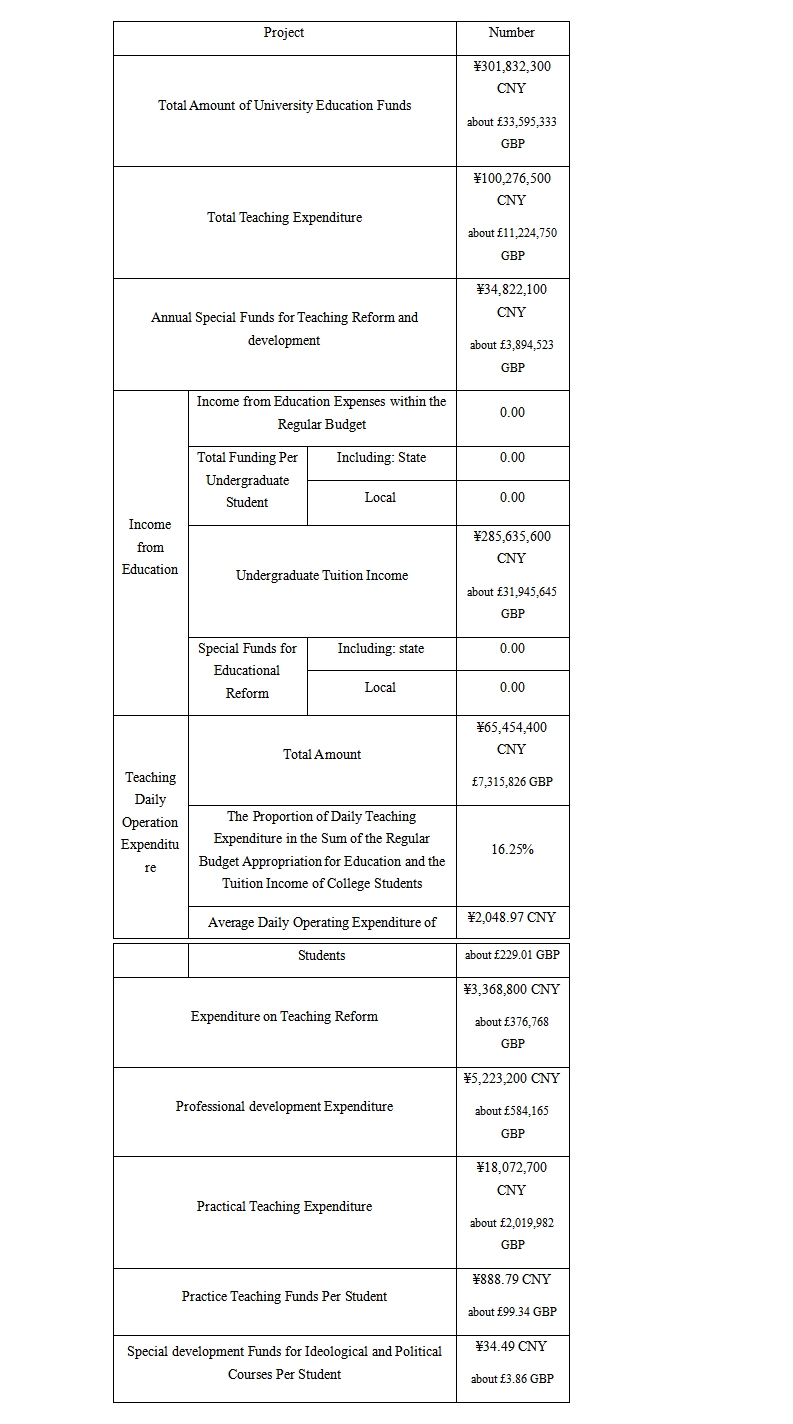
2.4 Teaching conditions
In accordance with the relevant provisions of the Ministry of Education of China "Basic Conditions for Running Ordinary Colleges and Universities (Trial)", the University ensures the quality of teaching conditions. The teaching infrastructure can better meet the basic requirements of personnel training, and the teaching conditions are generally up to the requirements of the Ministry of Education of China. All the basic conditions and monitoring conditions meet or exceed the qualification evaluation requirements.
2.4.1. Teaching Facilities
At present, the University has one campus, which is located in Yaohu University Park of Nanchang city in Jiangxi. The total area of teaching administration room is 503,992.33 square meters, including 258,154.92 square meters of classroom area (including 978.00 square meters of smart classroom area), 15.61 square meters of teaching administration room per student, 120,158.50 square meters of laboratory and practice place, and 1.15 square meters of laboratory per student. The gymnasium covers an area of 15,140.46 square meters. It has a playground area of 75,024.0 square meters. See table 2-7 for teaching and administrative rooms.
Table 2-7 General Situation of Teaching Facilities
2.4.2. Teaching and research equipment
The total assets value of teaching and scientific research instruments and equipment of the University are 270.5739 million yuan, and the average value of teaching and scientific research instruments and equipment per student is 8,400 yuan. In the academic year of 2019-2020, the value of new teaching and scientific research instruments and equipment was 13.4621 million yuan. At present, the University focuses on building three provincial and ministerial experimental teaching demonstration centers, namely Automobile Technology Center, Mechanical Foundation Experimental Center and Computer Center.
There are 237 laboratories and training places in the University, which cover all disciplines and majors in the University, and the practical teaching facilities are adequate. The University has set up open experimental projects and experimental elective courses. The opening degree of university laboratory is high. In the academic year of 2019-2020, the average utilization rate of 237 experimental (training) rooms is about 72.35%, which can well meet the requirements of student's multi-level experiment and training. See table 2-8 and table 2-9 for the number of experimental teaching demonstration centers at provincial and ministerial level, and the number of experimental practice and training places in the University.
Table 2-8 Provincial and Ministerial Experimental
Teaching Demonstration center
Table 2-9 Experimental, Internship, Training Places and Equipment
2.4.3. The development of library resources and campus network
The University has continuously improved its service quality. Through the development of mobile library and user's off campus access services, and the opening of WeChat public service platform, it has built a comprehensive and efficient storage, network and other technical system to provide literature and information services for teaching and scientific research in the mobile Internet environment. The library implements the service mode of full opening and large circulation. Literature retrieval realizes one-stop service of heterogeneous database, and inter-library literature network transfers and shares with each other, which meets the basic requirements of teaching and scientific research.
At present, the University has formed a campus network with a backbone bandwidth of 10000m, realizing full coverage of the wireless network campus, with a total collection of 2474200 paper books and an average of 76.64 paper books per student. In order to meet the learning needs of students, the University attaches importance to the introduction of e-book resources. At present, it has 373452 e-journals. The University library is open to all teachers and students, and online resources are open 24 hours a day (including winter and summer holidays). The complete library inventory is shown in table 2-10.
Table 2-10 Library Resources and Campus Network
Project |
University situation |
Core bandwidth of campus network (Mbps) |
10,000 |
Outlet bandwidth of campus network (Mbps) |
21,600 |
Number of network access information points |
32,130 |
Total volume of paper books |
2,474,200 |
Paper books per student |
76.64 |
New paper books added in the year |
91,647 |
The average number of paper books for every student |
2.84 |
Current book circulation |
178,612 |
Electronic Journal (volume) |
373,452 |
Dissertation (volume) |
7,323,732 |
Audio and video (hours) |
115,200.0 |
3. Teaching development and management reform
In order to educate applied students, the University optimizes the programme structure and improves the professional development, enrich the curriculum resources and optimize the practical education system and deepen the teaching reform and promote the quality of education and teaching.
3.1 Programme development
Optimizing the professional structure
It has become the trend of higher education reform and development to adjust the specialty setting and discipline structure according to the market demand for students, so as to make the specialty structure of higher education adapt to the requirements of social development. Through the prediction of the adjustment and development of the social and economic industrial structure, and through the analysis of the changes in the future occupation demand, we will apply to the Ministry of Education of China for new majors needed by the social and economic development, train the students needed by the emerging industries ahead of time, guide the industrial structure adjustment with the advantages of knowledge and students, and win the initiative for student's employment. The University mainly promotes programme development from the following three aspects:
At the same time, JXUT actively responds to the requirements of developing new economy and fostering new growth drivers in Jiangxi. In 2020, the University applies for five undergraduate majors, including Intelligent Manufacturing Engineering, Block Chain Engineering, Big Data Management and Application, Urban and Rural Planning, and Film and Television Photography and Production. It has basically formed a programme structure system that adapts the number of majors to the scale of running a University, the setting of majors to the social needs, the structure of majors to the development of disciplines, and the training objectives to the level of running a University.
Clear programme development ideas and promote the integration of disciplines and majors. In order to serve the regional economy, according to the 13th five year plan of discipline development of JXUT, the University has made clear the development ideas of disciplines and majors, fully integrated the advantageous resources, and built an "integrated" development system with discipline playing the leader role, major as the support, and curriculum as the backbone. And JXUT launched the "14th five year plan" discipline and specialty development planning work, studied and demonstrated the development direction, development orientation and development goal of each specialty of JXUT, focused on the development direction and characteristics, so as to steadily promote the programme development work.
Revise the education plan and refine the characteristics of programme development. According to the principles of ability as the core part of development, personality development, open innovation and characteristic cultivation, the University adheres to the principle of the programme development meets the talent demand, and constructs a student education system with application as the main line, ability as the core and innovation as the characteristic. In 2020, the University will complete the revision of student education plan of 2020, and the student education mode of "Two Platforms + N module + 1 system" will be optimized and improved. In accordance with the requirements of the national standard for teaching quality of undergraduate majors in ordinary colleges and universities and other relevant standards, the 2020 student education plan adheres to the OBE education concept as the guidance on the basis of the University running objectives and characteristics, and reversely designs the teaching process and teaching mode with the student as the center, so as to meet the market demand, industrial standards and enterprise requirements. We should further adjust and optimize the training program of applied students, optimize the knowledge structure, reconstruct the curriculum system, select the core courses, and clarify the course ownership. We strengthen the innovation education system, form the student education mode of "Two Platforms + N modules + 1 system", combine innovation education with professional education, run innovation education through the whole process of application-oriented talent training, and focus on cultivating student's innovation consciousness, innovation spirit and innovation ability. According to the new talent training plan in 2020, the University has completed the revision of the latest curriculum syllabus.
3.1.2 Steadily promoting the programme development level
The University strictly implements the programme development plan, comprehensively strengthens the development of professional software and hardware conditions, and implements the system of professional leaders and responsible persons. At present, the University has a total of 44 professional leaders, including 30 senior professional titles, accounting for 68.18%. According to the JXUT undergraduate professional head annual assessment and evaluation index system, the University has the year-end assessment of each professional head, and reasonably adjust the professional head according to the work needs of the University. See table 3-1 for the development of advantageous majors and table 3-2 for the professional leaders.
Table 3-1 list of advantageous programme development
Serial number |
Professional name |
Major type |
Time of establishment (year) |
|
1 |
Computer Science and Technology |
Selected into Outstanding Engineer Education and Training Program 2.0 |
2005 |
2 |
Automobile Service Engineering |
Selected as Outstanding Engineer Education and Training Plan 2.0; Professional, provincial first-class Professional development point |
2005 |
3 |
Mechanical Engineering and Automation |
Selected into Outstanding Engineer Education and Training Program 2.0 |
2009 |
Table 3-2 professional leaders
|
Total |
Title |
Academic degree |
Senior |
Deputy senior |
Other |
Doctor |
Master |
Other |
Number |
44 |
12 |
18 |
14 |
3 |
39 |
2 |
Proportion (%) |
/ |
27.27 |
40.91 |
31.82 |
6.82 |
88.64 |
4.54 |
3.2 Curriculum development
According to the layout of disciplines and majors, the University has formulated the curriculum development plan, issued the basic standard for undergraduate curriculum development, undergraduate curriculum evaluation plan, excellent online open curriculum development standard of JXUT, and online open course management method of JXUT, etc., which have defined the ideas, objectives and measures of curriculum development. Focus on building a number of quality courses and quality online open courses, and actively build a number of "golden courses" which is challenging for students. Through the introducing of online education curriculum platforms such as Supestar Erya and Wisdom Tree, we will actively create a number of online courses and those in classrooms that can reflect the level and characteristics of our University, establish a variety of courses including micro courses, quality courses, quality resource sharing courses and quality online open courses, and gradually form a multi-level online courses at the national, provincial and University levels.
In the academic year of 2019-2020, 1,116 courses were offered, including 966 professional courses and 102 public compulsory courses; there are 48 public elective courses, and the introducing of Erya and Wisdom Tree online courses. At the same time, a certain number of provincial excellent online open courses such as "Software Engineering", "Photography Technology and Art" and high-quality University level excellent courses such as "College English", "Introduction to basic principles of Marxism" have been set up. It is a rational choice to fully meet the needs of students for knowledge and ability development. See table 3-3 for the opening of courses in the whole University.
Table 3-3 Courses offered in the whole University
Course category |
Number of courses |
Proportion of courses taught by teachers with senior professional titles |
Number of courses |
Number of Bilingual Courses |
Average Teaching hours |
Average class size (person) |
Professional courses |
966 |
50.41 |
3052 |
11 |
39.51 |
68.15 |
Public compulsory course |
102 |
59.80 |
1806 |
16 |
32.13 |
112.87 |
Public elective courses |
48 |
35.42 |
75 |
0 |
30.72 |
102.08 |
Notes: This table does not include online courses
With regard to class size, in the academic year 2019-2020, 4,933 courses were offered, including 301 courses for 30 people and below, 2,224 courses for 31-60 people, 1,365 courses for 61-90 people, and 1,043 courses for more than 90 people. In the course teaching arrangement, strictly control the scale of the course, so as to focus on small and medium class teaching, to ensure the quality of teaching. See table 3-4 for the scale of the whole University.
Table 3-4 Curriculum scale of the whole University
3.3 Teaching resources
In order to improve the standards and procedures for the selection of teaching materials and improve the management methods of teaching materials, the ‘Administrative measures for the selection of teaching materials of JXUT and Administrative measures for the introduction of overseas original teaching materials of JXUT" have been issued to clarify the selection principle of teaching materials, follow the new principle of selection and optimization, check and discard the substandard teaching materials and old teaching materials. In order to strictly control the selection of teaching materials. The selection of teaching materials must be fully discussed and demonstrated by the teachers organized by the director of the teaching and research section, and submitted to the general Party branch of the college for political guidance, and then submitted to the University for approval. The ideological and political theory course must use the national textbook. The related courses of Philosophy and Social Sciences should use the key textbooks of Marxist theoretical research and development engineering designated by the state.
3.4 Implementation of practical teaching
Based on the orientation of applied student education objectives, the University pays attention to the development of student's comprehensive ability, professional ability and innovation ability, optimizes the overall system design of all kinds of practical teaching links, such as experiments, training and internships, highlights the cultivation of student's innovative spirit and practical ability, and constructs a three-sphere integrated system, which adapts to the student education objectives, matches the theory teaching, and improves the quality of teaching as the core.
3.4.1 Solid development of laboratory and practical teaching base and reasonable operation of practical teaching
The organisation of laboratory and teaching practice base is solid. The University has three provincial and ministerial experimental teaching demonstration centers, including Automobile Technology Center, Computer Center and Mechanical Foundation Experimental Center, and more than 200 experimental and practice sites. The laboratory covers all disciplines and majors of the University. Students are educated through the cooperation of University and enterprises, University and associations, University and government, and different universities. For example, the University cooperates with more than 200 enterprises inside and outside the province, such as Nanchang Chaoteng Technology Co., Ltd. and Intercontinental Group, and thousands of people enter these enterprises for internship and training every year. In cooperation with Huawei Technology Co., Ltd., Superstar Information Technology Development Co., Ltd. and other domestic well-known enterprises, we have hired enterprise tutors to give lectures and carried out order based talent training. By 2020, we have opened more than 20 order classes (refer to classes that are jointly cultivated by the University and companies). In the academic year of 2019-2020, JXUT has mainly carried out the development of comprehensive management service platform of laboratories and private education special fund project in laboratory management and development.
In order to ensure the orderly development of experimental (training) room teaching and scientific, standardized, safe and efficient laboratory management, the University purchased Zhongxin Tianda intelligent experimental (training) room comprehensive management service platform. In order to make full use of the system, scientifically and effectively manage the laboratory (training) room, ensure the accuracy and integrity of the basic data required by the laboratory data reporting, and solve the problems existing in the process of information data entry in a timely manner, the University has carried out the online and offline system training of the laboratory management comprehensive platform, so as to provide a series of data reports more scientifically, reasonably and accurately, to provide support for the development of University laboratories.
The University pays attention to the student's practice teaching link, adheres to the goal of ability training, tamps the foundation of practice teaching, reasonably sets up the practice teaching curriculum, and forms a scientific and reasonable practice teaching operation mechanism. The University has issued a series of management regulations, such as the Measures for the management of practice teaching in JXUT, the Measures for the assessment of laboratory management in JXUT, and the Standard for experimental teaching in JXUT. It has continuously increased the investment in laboratory funds, improved the conditions of experimental teaching, and improved the level of laboratory development. Last, the evaluation and monitoring system of experimental teaching based on process management is established to ensure the effect of experimental teaching.
3.4.2 Good quality of management standards of undergraduate dissertation (design)
The University attaches great importance to the work of student's graduation dissertation (Design). It has issued the Compilation of management system for undergraduate graduation thesis (Design) of JXUT, compiled and printed the Guidance for graduation thesis (Design) writing and defense, and put forward clear requirements in the aspects of topic selection, process guidance, evaluation, defense, scoring, and achievement filing, adhering to the principle of “Triple Strictness”, that is to strictly review the topic selection, strictly manage the process, and strictly grasp the graduation defense.
Topic selection is strictly inspected. It is required that the subject selection of science and engineering majors should be based on engineering practice, and the subject selection of liberal arts majors should be closely combined with professional characteristics, production reality and social reality. The vast majority of the topics in 2020 will be completed in practical activities such as experiment, practice, engineering practice and social investigation.
Process is strictly managed. The initial and mid-term inspection are strengthened. The initial inspection includes the topic selection application form, topic selection registration form, task book, opening report, etc. the mid-term inspection includes the rectification of the initial inspection, the supplement and improvement of the task book, the implementation of the graduation thesis (Design) plan, and the management manual for the graduation thesis (Design) process, etc.
Graduation defense is strictly controlled. The University has introduced "CNKI college student's thesis detection system" to detect the copy ratio of all student's final graduation thesis (Design). If the copy ratio is higher than 30%, the thesis will fail, the system of blind examination of graduation thesis (Design) is carried out. A certain proportion of graduation thesis (Design) is randomly selected from various majors every year and sent to similar universities in the province for blind examination. The qualification of student's defense should be strictly examined, and the qualification of student's defense should be determined according to the opinions of the instructor and the reviewing teacher.
The quality of papers is strictly observed. The University carries out the selection activities of outstanding graduation thesis (Design) and excellent tutor every year. In 2020, 36 excellent graduation thesis (Design) and 36 excellent tutors will be selected. In the academic year of 2019-2020, a total of 4,423 graduation thesis (Design) topics were selected by undergraduates, and 613 tutors guided the graduation thesis (Design).
3.4.3 Perfect Graduation Practice System and Clear Division of Labor
JXUT has set up a leading group for graduate internship to strengthen the organization, coordination and leadership of graduation internship, and clarify the responsibilities and tasks. The organization and management of graduation internship, the use of internship funds, practice base development and so on have been clearly defined through the formulation of JXUT Internship Management Measures, JXUT graduates internship implementation plan and other related guidance. The graduation practice units are required to have cooperation agreements, teaching plans, process monitoring and quality assurance of results. Each secondary college formulates corresponding implementation rules, and puts forward specific requirements for instructors, internship plan and process management, so as to ensure the standardization of graduate internship.
3.4.5 Deepening the cooperation between university and enterprise and celebrating achievements
The first is to build off campus practice base. JXUT promotes the development project of "100 close cooperative enterprises", issues the "selection criteria for close cooperative enterprises of JXUT" And the University has signed cooperation agreements with more than 300 enterprises to carry out personnel training cooperation. The second is to set up industry colleges to train students for the forefront of the industry. The Academy of art and design has cooperated with the advertiser culture group to set up the advertiser college. The third is to strengthen order education, promote the development project of "100 order classes", and issue the "order education (refer to an education mode with classes jointly cultivated by University and companies) management measures of JXUT". In the academic year of 2019-2020, the University has set up more than 20 order classes, covering 5 colleges and more than 10 majors, with an employment rate of 97.3%. The fourth is to build a team of double qualified teachers. Teachers can obtain professional qualification certificates through enterprise training and internship. At the same time, enterprise tutors are introduced as double qualified teachers to JXUT.
3.5 Innovation and entrepreneurship education
In order to strengthen innovation and entrepreneurship education, the University has issued the evaluation index system of innovation education of JXUT. At the same time, it has formulated the evaluation and evaluation methods of innovation education of innovation classes of JXUT from six aspects: atmosphere creation, policy guidance, teacher guidance, team management, performance evaluation, and excellence evaluation, so as to further improve the management system of innovation education, Through these methods, JXUT effectively guides, encourages and guarantees teachers and students to actively participate in innovation and entrepreneurship activities. In the academic year of 2019-2020, the University has 24 new innovative classes (refer to classes that been cultivated emphatically by the University and relevant cultivating policies) and 104 existing innovative classes with 4894 students.
3.6 Teaching reform
3.6.1 Orderly promoting the "new measures" of teaching reform
In order to continuously deepen the curriculum reform, the University has organized teachers to carry out curriculum reform since 2018. A total of 17 courses from 13 colleges and departments participated in the curriculum reform. In November 2019, 14 pilot courses selected from the School of Intelligent Engineering, the School of Information Engineering, the School of Civil Engineering, etc. were rated as excellent and good. The curriculum reform has promoted the transformation of teacher's classroom teaching methods, changed the tendency of paying too much attention to knowledge teaching, and improved teacher's teaching level.
3.6.2 Formulating the "new plan" of online teaching reform
In the process of promoting the teaching reform, the University fully implements the work requirements of "relying on the online course platform or management system, actively carrying out online teaching activities, deeply integrating information technology with education and teaching, promoting the reform of learning methods, and ensuring the teaching progress and quality during the pandemic prevention and control period". According to the spirit of "guiding opinions on online course teaching of undergraduate colleges and universities in Jiangxi Province" issued by Jiangxi Provincial Department of education, combined with the circumstances of the pandemic, the "guiding opinions on online course teaching of JXUT in the second semester of 2019-2020 academic year" was issued to change the traditional teaching mode and promote the online course teaching reform. According to the deployment of teaching work during the pandemic period of the University, a unified linkage mechanism between the University and the college should be established. We should adhere to relevant requirements and standards of the Ministry of Education of China, hold special meetings for many times, analyze and judge the impact of the pandemic situation on our teaching work, and formulate corresponding emergency plans to ensure the orderly and smooth progress of teaching work. JXUT has urged all teaching units to hold online teaching seminars, study and formulate online teaching preparations and implementation plans, publicize and mobilize teachers and students, ideologically improve the understanding of the importance of the integration and development of modern information technology and education and teaching reform, and adapt to the new ideas, new models and new methods of teaching under the new situation as soon as possible, During the holidays, teachers skillfully use various teaching platforms to make preparations for online teaching during the circumstances of the pandemic.
3.6.3 Exploring the "new mode" of online teaching reform
On the basis of multi-party research, the University carefully studied the platform development, teaching mode, quality monitoring and other contents of online teaching, and strived for resources through multiple channels to ensure the smooth progress of online teaching throughout the pandemic. This has included building a network teaching platform based on Superstar learning platform, and other platforms work together to train the whole University staff on the course of "online teaching", match the identity information of teachers and students of the whole University on the platform, and provide technical support. The University online teaching preparation work is comprehensive, the policy formulation is timely, the risk control is in place, and has achieved the expected goal of "substantial equivalence" with classroom teaching.
3.6.4 Carrying out "new activities" of teaching reflection case evaluation
In order to promote the development of our University's education and teaching work, to further improve the quality of education and teaching, to help teachers find and solve problems in time, to change teaching concepts, to constantly improve teaching methods, and to strengthen teaching impact, according to the spirit of relevant documents, the University has organized and carried out two sessions of "excellent teaching reflection case evaluation" activities since the first period of 2019-2020 academic year. A total of 113 excellent teaching reflection cases submitted by all teaching departments of the University were collected. Experts and supervisors in the University were organized to evaluate and score. A total of 71 teachers including Li Xiangqin won the first, second and third prizes respectively. Through the selection of excellent teaching reflection cases, teachers can constantly update teaching best practices, reform teaching methods and pursue high-quality classroom teaching in the process of reflection on their own teaching work, so as to lay the necessary foundation for improving the level of university education and teaching.
4. Development of online teaching in response to the pandemic
4.1 General situation
In order to thoroughly implement the Ministry of education's work requirements of " ensuring learning uninterrupted when classes are disrupted" and "ensuring the effectiveness of online teaching", and minimize the impact of pandemic prevention and control on teaching work, according to the implementation plan of the second semester of the 2019-2020 academic year of JXUT, a high opening rate of online teaching has been guaranteed in the past two months. There are 1,208 courses to be opened, and 1,116 courses are actually opened, with the opening rate of 92.38%. The actual number of online learning students reached more than 30,000. Teachers make full use of all kinds of teaching platforms such as Superstar (Xuexitong) and various teaching forms such as Tencent Conference, QQ, WeChat, Ding Talk and Tencent Classroom to exchange and guide with students, and conduct online teaching through "live teaching", "video teaching", "SPOC teaching", "online Seminar Teaching" and "student's Autonomous Learning". During the pandemic period, the online teaching preparation work was sufficient, the policy formulation was timely, the risk control was in place, the teaching operation was generally stable, and the expected goal of "substantial equivalence" with classroom teaching was basically achieved. With a positive attitude, the teachers and students completed the education campaign of "class suspension without University suspension".
4.2 Main measures
4.2.1 Plan and start in advance, and fully deploy online teaching
According to the deployment of teaching work during the pandemic period of the University, a unified linkage mechanism between the University and the college should be established. We should conscientiously implement the relevant spirit of the superior departments, hold special meetings for many times, analyze and judge the impact of the pandemic situation on our teaching work, and formulate corresponding emergency plans to ensure the orderly and smooth progress of teaching work. The University urges all teaching units to hold online teaching seminars, research and develop online teaching preparations and implementation plans, attaches great importance to online teaching ideologically, improves the understanding of the importance of the integration and development of modern information technology and education and teaching reform, and rapidly adapts to the new ideas, new models and new methods of teaching under the circumstances of the pandemic. During the holidays, teachers skillfully use various teaching platforms to make preparations for online teaching during the pandemic period.
4.2.2 Build resource platform and optimize online teaching scheme
The University has combined the resources of 22 different online teaching platforms from throughout China to develop a single platform based on the Superstar learning platform, that remains compatible with existing platforms. It carries out the course training of "online teaching based on one flatform and three terminals (refer to the University, students and teachers)" for the whole University staff, matches the identity information of teachers and students on the platform, and provides technical support.
4.2.3 Carry out accurate training to improve online teaching skills
The University has established an online teaching technology exchange group, and carried out online teaching training and online Q & A work with online teaching platforms such as Aike and Chaoxing Erya. All teaching units actively communicate with each other and hold regular online teaching exchange promotion meetings to strengthen communication and exchange experience.
The University also makes full use of WeChat public official account and official website to promote the information transmission of online teaching for all teachers and students. During the pandemic prevention and control period of JXUT, some problems about online teaching are discussed to solve the practical problems encountered in the course development.
4.2.4 Timely analysis and summary to improve online teaching methods
In order to fully understand the effect of student's online learning and teacher's online teaching, the University sent questionnaires to teachers to collect student's learning satisfaction, teacher's teaching effect, problems and suggestions in the teaching process, and efficiently complete the survey statistics and analysis reports, so as to help teachers continuously improve online teaching methods and improve the teaching level. In view of the problems such as system failure encountered during online teaching, we organized all teaching units to prepare "online teaching emergency plan" to provide technical support for solving online teaching problems.
4.2.5 Continuous improvement of online teaching assessment procedures
In order to standardize the management of online teaching, ensure the orderly operation of online teaching, monitor the quality of online teaching, and achieve the purpose of substantial equivalence between online learning and offline classroom teaching quality, the University issued the implementation plan of online teaching supervision and assessment of JXUT as the guiding document of teaching supervision.
The University issued the notice of early teaching inspection, which specifically explained the key inspection items, inspection contents and requirements during online teaching, and established a multi-dimensional, multi angle, multi-level and all-round supervision and monitoring system. At the same time, the appropriate teaching platform was chosen to allow University supervisors and deputy deans for teaching affairs of each college to monitor daily online teaching in real time, leading to the resolution of quality assurance issues as they develop. All members of each teaching management unit go deep into the teaching front line and carry out quality monitoring together with the inspection team of each secondary college.
The University has formulated a daily reporting system of online teaching data to ensure the timely management of quality assurance in teaching across the entire university. At the same time, the University provides a comprehensive network teaching activities service guarantee to ensure the correct ideological guidance in the selection (production) of network teaching resources, strict discipline in the network classroom, fair and transparent learning evaluation, and standardized supervision and inspection, so as to comprehensively guarantee the teaching quality.
4.3 Innovative measures
4.3.1 Make the teaching plan of peak shifting
In order to prevent the network server from getting stuck in the teaching process, our university has issued a notice on printing and distributing the "staggered peak" schedule of online teaching time in the second semester of JXUT in 2019-2020 academic year. Students from 11 secondary schools have classes in 4 different time slots to avoid internet lag. Teachers also prepared a number of alternative programs, such as "QQ group / Tencent conference voice", "Tencent conference voice + text + PPT", "QQ voice + text + PPT / document", "QQ (text guidance) + Learning link (courseware and test)" and other ways to actively guide students to carry out online learning.
4.3.2 Set up technical leading group
In order to ensure the smooth development of courses for teachers and reduce the tedious communication between teachers and the platform, the University has set up the "online teaching technology leading group of JXUT" in various departments. The purpose is to explore the "elite experts" of online teaching courses in the teaching team, play the guiding role of "helping and guiding" in the whole University, and effectively solve the practical problem of teacher's difficulty in building courses.
4.3.3 Carry out simulated online teaching
In order to ensure the normal and orderly development of online teaching during the period of pandemic prevention and control, according to the document requirements of Guidance on online teaching in the second semester of 2019-2020 academic year of JXUT, the University issued The notice on the trial operation of online teaching and carried out a one week "trial operation" of online teaching from February 24th to March 1st. Through the trial operation, the University collected 259 feedback problems from various teaching units, and summarized them into 22 categories. Aiming at these problems, the University studied the solutions and issued "feedback and proposed countermeasures for problems in the first stage of trial operation". The purpose is to find and solve the problems existing in online teaching in time, and ensure the order and quality of online teaching.
4.3.4 Issue risk control report
Before the formal implementation of online teaching, in order to prevent the possible risks in the process of teaching operation, the University formulated the corresponding emergency plan, issued the Risk control report of JXUT on online teaching, and gave the guiding prevention and proposed solutions to the possible operational risks, for the reference of secondary colleges and relevant teaching departments.
4.3.5 Start the emergency plan
Eleven secondary colleges and 3 teaching departments of JXUT have formulated the corresponding Emergency plan for online teaching of JXUT (Teaching Department) according to their respective discipline characteristics, which makes it clear to start the plan under abnormal conditions and ensures the orderly development of online teaching.
4.4 Good results
The new "online teaching" mode has been accepted by the majority of teachers and students, and has achieved remarkable results. From the teacher's point of view: teachers combine the curriculum, use the appropriate online platform for teaching, improve student's interest in learning, teacher's teaching objectives focus more on student's learning effect, the majority of teachers consciously take student's learning effect as an important yardstick to measure their own teaching, and "student-centered" culture is increasingly popular.
4.5 The change of direction
The deep integration of online teaching and offline teaching will be the inevitable trend of future classroom teaching, which is both a challenge and an opportunity for teaching work; It is not only the need of teaching, but also the need of teaching reform. After switching to offline teaching, teachers are encouraged to continue to adopt the "Online + offline" blended teaching method, make full use of all kinds of data deposited on the platform during online teaching, carry out learning situation analysis, use all kinds of online virtual simulation experiment and training teaching platforms to carry out online and offline hybrid experiment and training teaching activities, and use classroom teaching to check and fill gaps, answer questions and solve doubts, complete the interactive interaction that online teaching can not carry out, so as to promote the teaching reform. To realize the transformation from the traditional classroom "Teacher centered" which focuses on one-way indoctrination to the "Online + offline" blended teaching mode which focuses on interactive dialogue and "student's Autonomous Learning", classroom teaching and modern information technology can be deeply integrated, from "freshness" to "new normal".
After the pandemic, the long-term coexistence and deep integration of "traditional classroom" and "online classroom" in our University will become the norm. This integration will move from physical reaction to chemical reaction, giving birth to new education forms and new talent training methods such as "online and offline Hybrid Teaching". Through the continuous promotion of online teaching, the majority of teachers recognize the power and value of educational technology, and turn the "freshness" of online teaching into the "new normal" of teaching and learning in higher education, which will be a major issue to be considered in deepening the teaching reform of colleges and universities, realizing the connotative development, and improving the quality of personnel training.
5. Professional training ability
Following the teaching law of higher education and based on the orientation of running a University, the University has established the goal of training high-quality application-oriented talents with expertise and innovation ability to meet the needs of economic and social development. Starting from the formulation of talent training program, the guarantee of teaching conditions and the development of teaching resources, the University constantly strengthens the cultivation of student's professional ability, and effectively improves student's professional ability, so as to meet the social demand for talents.
5.1 Professional training objectives
5.1.1. Reasonable development of training mode
The University insists on the guidance of Xi Jinping's new socialist ideology with China's characteristics, and sets up the concept of talent cultivation based on "student oriented, results oriented and service needs". It adheres to the principle of “majors meet to the needs of local leading industry, student education goals meet to the needs of the whole industry, and student education meets the needs of occupational demand. To cultivate high-quality applied students with expertise and innovation ability to meet the needs of economic and social development. The University has deepened the reform of the talent training mode of "Two Platforms + N modules + 1 system", continuously improved seven systematic innovative education systems, built a "three in one" practical teaching system that is compatible with the training objectives of applied talents, coordinated with curriculum theory teaching, and focused on improving ability, and made efforts to build four cooperation platforms between University and enterprise, University and government, University and association, and different universities. Efforts should be made to open up universities and actively promote international exchanges and cooperation and internationalization strategy. To educate high-quality application-oriented students with expertise and innovation ability to meet the needs of economic and social development.
5.1.2. Revise the training plan scientifically
Guided by social needs, according to the training requirements of application-oriented undergraduate talents, on the basis of fully reflecting the University running objectives and characteristics of the University, combined with the "national standard for undergraduate professional teaching quality of ordinary colleges and universities", professional certification standards, industry standards and professional comprehensive evaluation and other professional development standards, the undergraduate professional talents training program is revised. According to the training objectives, we should further clarify the graduation requirements of knowledge, ability and quality, so as to scientifically and reasonably construct the curriculum system and strictly design the realization matrix of knowledge, ability and quality structure. At the same time, widely utilise industry, enterprises and other professionals to participate in the demonstration of talent training program.
5.1.3. Strictly implement the training plan
The University clearly proposes that the formulation of a talent training plan should be subject to two-level management. At the University level, the academic affairs office should formulate the principle opinions, and the secondary college is responsible for formulating the training plan and implementing the teaching plan. The University has improved the examination and approval system for the adjustment of talent training programs, and achieved the goal of planning the opening of classes, applying for changes, demonstrating the adjustment, and monitoring the process. See Table 5-1 and table 5-2 for the proportion of professional credits of various disciplines.
Table 5-1 Credits of various disciplines
Subject categories |
Number of Majors |
Average total professional credits |
Average proportion of professional practice teaching credits (%) |
Engineering |
14 |
168.82 |
44.87 |
Education |
2 |
160.0 |
51.25 |
Literature |
5 |
156.6 |
42.77 |
Medical Science |
2 |
165.0 |
49.87 |
Management |
10 |
159.2 |
36.9 |
Economics |
4 |
160.0 |
32.97 |
Arts |
9 |
161.67 |
58.06 |
Table 5-2 Credit setting details of each major
Name of major on campus |
Total credits |
Required course credits |
Credits of elective courses |
Centralized practice credit |
In class teaching credits |
Experimental teaching credits |
Proportion of practice teaching credits (%) |
Economics |
160 |
140 |
20 |
32 |
108 |
20 |
32.5 |
Financial Engineering |
160 |
140 |
20 |
32 |
108 |
20 |
32.5 |
Investment Principles |
160 |
140 |
20 |
32 |
108 |
20 |
32.5 |
International Economy and Trade |
160 |
140 |
20 |
33 |
105 |
22 |
34.38 |
Preschool Education |
160 |
140 |
20 |
33 |
78 |
49 |
51.25 |
Primary Education |
160 |
140 |
20 |
32 |
78 |
50 |
51.25 |
Chinese Linguistic Literature |
155 |
131 |
24 |
32 |
93 |
30 |
40 |
English |
160 |
122 |
38 |
30 |
96 |
34 |
40 |
Business English |
160 |
140 |
20 |
32 |
84 |
44 |
47.5 |
Journalism |
154 |
128 |
26 |
33 |
92 |
29 |
40.26 |
Network and New Media |
154 |
128 |
26 |
33 |
83 |
38 |
46.1 |
Applied Psychology |
160 |
140 |
20 |
28 |
79 |
53 |
50.62 |
Mechanical Engineering |
169 |
149 |
20 |
36 |
94.5 |
38.5 |
44.08 |
Mechanical Engineering and Automation |
170 |
150 |
20 |
39 |
95.5 |
35.5 |
43.82 |
Vehicle Engineering |
170 |
150 |
20 |
39 |
98.5 |
32.5 |
42.06 |
Automobile Service Engineering |
170 |
150 |
20 |
37 |
100.5 |
32.5 |
40.88 |
Materials Science and Engineering |
170 |
147 |
23 |
36 |
95 |
39 |
44.12 |
Communication Engineering |
169 |
143 |
26 |
36 |
91 |
42 |
46.15 |
Robot Engineering |
170 |
150 |
20 |
38 |
96.5 |
35.5 |
43.24 |
Computer Science and Technology |
169 |
143 |
26 |
30 |
89 |
50 |
47.34 |
Software Engineering |
170 |
143 |
27 |
30 |
86 |
54 |
49.41 |
Network Engineering |
169 |
143 |
26 |
35 |
87 |
47 |
48.52 |
Internet of Things Project |
168 |
141 |
27 |
31 |
86 |
51 |
48.81 |
Data Science and Big Data Technology |
170 |
148 |
22 |
36 |
82 |
52 |
51.76 |
Civil Engineering |
169.5 |
141 |
28.5 |
33 |
103.5 |
33 |
38.94 |
Nursing |
170 |
152 |
18 |
44 |
86.5 |
39.5 |
49.12 |
Engineering Management |
160 |
133 |
27 |
32 |
97.5 |
30.5 |
39.06 |
Cost Engineering |
160 |
133 |
27 |
32 |
97.5 |
30.5 |
39.06 |
Business Administration |
158 |
138 |
20 |
31 |
105 |
22 |
33.54 |
Marketing Management |
160 |
140 |
20 |
32 |
106 |
22 |
33.75 |
Accounting |
160 |
140 |
20 |
30 |
99 |
31 |
38.12 |
Financial Management |
160 |
140 |
20 |
30 |
98 |
32 |
38.75 |
Human Resource management |
160 |
140 |
20 |
32 |
106 |
22 |
33.75 |
Health Services and Management |
160 |
141 |
16 |
30 |
95 |
35 |
40.62 |
Logistics Management |
156 |
133 |
23 |
30 |
104 |
22 |
33.33 |
Electronic Commerce |
158 |
138 |
20 |
29 |
88 |
41 |
44.3 |
Tourism Management |
160 |
138 |
22 |
32 |
106 |
22 |
33.75 |
Musicology |
160 |
140 |
20 |
32 |
64 |
64 |
60 |
Dancology |
164 |
144 |
20 |
25 |
43 |
96 |
73.78 |
Literature of Theatre Film and Television |
161 |
135 |
26 |
32 |
97 |
32 |
39.75 |
Radio and Television Editor |
161 |
135 |
26 |
32 |
91 |
38 |
43.48 |
Broadcasting & Hosting Art Profession |
159 |
137 |
22 |
32 |
68 |
59 |
57.23 |
Animation |
163 |
125 |
38 |
30 |
62.25 |
70.75 |
61.81 |
Visual Communication Design |
163 |
130 |
33 |
30 |
60.25 |
72.75 |
63.04 |
Environmental Design |
161 |
121 |
40 |
30 |
63.75 |
67.25 |
60.4 |
Clothing and Clothing Design |
163 |
125 |
38 |
32 |
60.25 |
70.75 |
63.04 |
5.2 Professional teaching conditions
5.2.1. The development of professional teaching staff and the ratio of students to teachers
In the 2019-2020 academic year, the total number of full-time teachers increased from 1,392 to 1,572, including 151 doctors and 1067 masters, accounting for 77.48%.With the gradual enhancement of the teaching staff, the overall student teacher ratio has decreased from 18.27:1 to 18.19:1. All majors have also reasonably introduced, allocated and trained professional full-time teachers, continuous improved University running conditions, and the student teacher ratio has also been continuously optimized. In the 2019-2020 academic year, there are only 8 majors with a student teacher ratio of more than 20:1, and the teaching guarantee is orderly. The ratio of undergraduates to full-time teachers is shown in table 5-3.
Table 5-3 Situation of undergraduates and full-time teachers
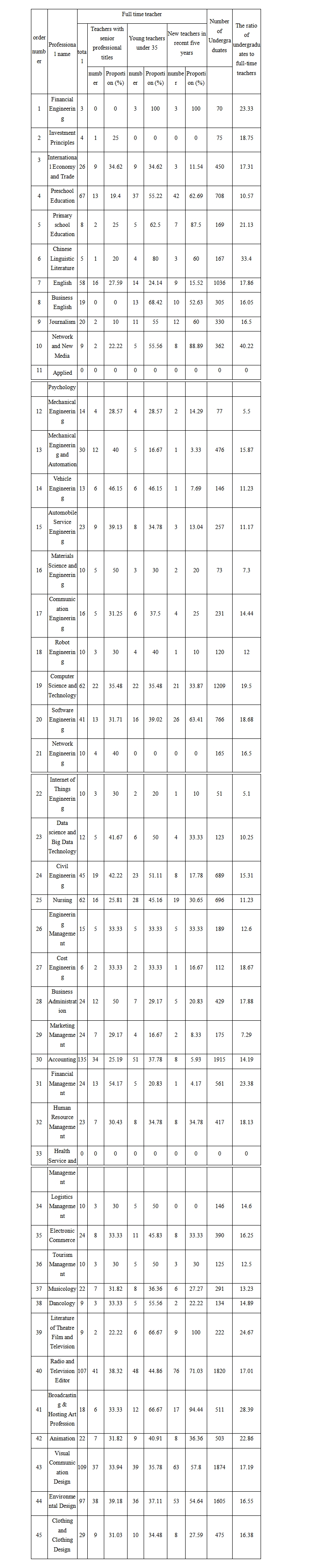
5.2.2 Organization of practical teaching and practical training base for various majors
According to the application-oriented running orientation, the University has always attached great importance to practical teaching, and made great efforts from the formulation of training programs to the development of practical teaching sites.
According to the needs of work and the actual situation, the University has 230 experimental (training) rooms, covering all disciplines and majors, with complete practical teaching equipment. In 2020, a total of 13.4621 million yuan of new teaching and scientific research instruments and equipment will be added in all teaching units. In accordance with the principle of student-centered and comprehensive opening, public experimental projects and experimental elective courses have been set up. The utilization ratio of university laboratories is high. In order to meet the needs of student's practice and training, we also signed agreements with many well-known enterprises inside and outside the province, and built 285 off campus practice and training practice teaching bases with stable cooperation, which can better meet the teaching needs of student's professional practice. See table 5-4 for the use of laboratories in the University.
Table 5-4 use of laboratory in university

5.3 Professional student education
5.3.1 Organization and development of curriculum system
According to the layout of disciplines and majors, the University has formulated the curriculum development plan, focusing on the development of a number of excellent courses and Open Online Courses. We should establish a scientific and standardized curriculum library, comprehensively promote the development of public basic courses, professional basic courses, professional core courses, professional elective courses and public elective courses, and actively develop bilingual courses, so as to provide a three-dimensional curriculum system for the education of professional students. In the academic year of 2019-2020, there are 1183 courses, including 966 professional courses and 11 bilingual courses. At the same time, each major also set up professional elective courses and professional optional courses. In order to enrich the curriculum resource database, the University has introduced more than 200 online elective courses, such as Chaoxing Erya -the general education course and Wisdom Tree online education course, which can better meet the student's demand for rational choice of knowledge and ability structure. The Massive Open Online Courses are shown in table 5-5
Table 5-5 Massive Open Online Courses
Type |
National Level |
Provincial Level |
Others (including university level) |
Self-built |
Introductory |
Self-built |
Introductory |
Self-built |
Introductory |
Open Online Courses |
0 |
5 |
6 |
2 |
9 |
0 |
MOOC |
0 |
0 |
0 |
0 |
17 |
12 |
SPOC |
0 |
0 |
0 |
0 |
0 |
14 |
Classes given by professors of various majors
In the academic year of 2019-2020, in addition to concentrated practice and network elective courses, the University opened 1183 courses. In order to improve the quality of undergraduate teaching, the University attaches great importance to the situation that senior professional title teachers teach for undergraduates, and strictly implements the provisions on professors and associate professors teaching for undergraduates. In the academic year of 2019-2020, the University has 88 professors (including administrators), 68 of whom deliver lessons for students, accounting for 76.83% of the total number of professors. As far as all majors are concerned, the teaching proportion of professors and associate professors has also increased year by year. See table 5-6 for the teaching situation of teachers in all majors.
Table 5-6 teaching situation of teachers in all majors
Number |
Major |
Teacher |
Senior title |
Professor |
Total |
Number of courses undertaken |
Number |
Proportion (%) |
Number |
Proportion (%) |
1 |
Computer Science and Technology |
36 |
33 |
27 |
75 |
4 |
11.11 |
2 |
Finance Engineering |
6 |
6 |
4 |
66.67 |
1 |
16.67 |
3 |
Visual Communication Design |
66 |
35 |
42 |
63.64 |
7 |
10.61 |
4 |
Environmental Design |
73 |
35 |
45 |
61.64 |
2 |
2.74 |
5 |
Data Science and Big Data Technology |
10 |
9 |
6 |
60 |
0 |
0 |
6 |
Robot Engineering |
14 |
17 |
8 |
57.14 |
1 |
7.14 |
7 |
Civil Engineering |
32 |
35 |
18 |
56.25 |
1 |
3.13 |
8 |
Network Engineering |
27 |
38 |
15 |
55.56 |
2 |
7.41 |
9 |
Communication Engineering |
28 |
46 |
15 |
53.57 |
2 |
7.14 |
10 |
Mechanical Design and Manufacture and Automation |
30 |
34 |
16 |
53.33 |
3 |
10 |
11 |
Automobile Service Engineering |
29 |
32 |
15 |
51.72 |
3 |
10.34 |
12 |
Internet Engineering |
10 |
13 |
5 |
50 |
1 |
10 |
13 |
Software Engineering |
16 |
16 |
8 |
50 |
1 |
6.25 |
14 |
International Economy and Trade |
36 |
50 |
17 |
47.22 |
2 |
5.56 |
15 |
Preschool Education |
39 |
32 |
17 |
43.59 |
3 |
7.69 |
16 |
Literature of Theatre Film and Television Literature |
7 |
7 |
3 |
42.86 |
0 |
0 |
17 |
Cost Engineering |
7 |
7 |
3 |
42.86 |
0 |
0 |
18 |
Animation |
17 |
35 |
7 |
41.18 |
1 |
5.88 |
19 |
Electronic Commerce |
27 |
39 |
11 |
40.74 |
3 |
11.11 |
20 |
Journalism |
25 |
27 |
10 |
40 |
2 |
8 |
21 |
Vehicle Engineering |
23 |
32 |
9 |
39.13 |
1 |
4.35 |
22 |
Materials Science Engineering |
18 |
30 |
7 |
38.89 |
2 |
11.11 |
23 |
Business Administration |
31 |
38 |
12 |
38.71 |
1 |
3.23 |
24 |
Accounting |
114 |
42 |
42 |
36.84 |
2 |
1.75 |
25 |
Radio and Television Editor |
50 |
26 |
18 |
36 |
4 |
8 |
26 |
Engineering Management |
25 |
32 |
9 |
36 |
1 |
4 |
27 |
Mechanical Engineering |
14 |
19 |
5 |
35.71 |
1 |
7.14 |
28 |
Business English |
26 |
26 |
9 |
34.62 |
2 |
7.69 |
29 |
Nursing |
56 |
47 |
19 |
33.93 |
1 |
1.79 |
30 |
Human Resource Management |
24 |
32 |
8 |
33.33 |
2 |
8.33 |
31 |
Tourism Management |
21 |
33 |
7 |
33.33 |
1 |
4.76 |
32 |
Dancology |
9 |
27 |
3 |
33.33 |
2 |
22.22 |
33 |
Network and New Media |
22 |
27 |
7 |
31.82 |
1 |
4.55 |
34 |
English |
48 |
38 |
15 |
31.25 |
3 |
6.25 |
35 |
Investment Principles |
24 |
35 |
7 |
29.17 |
0 |
0 |
36 |
Broadcasting & Hosting Arts Profession |
21 |
16 |
6 |
28.57 |
0 |
0 |
37 |
Logistics Management management |
22 |
30 |
6 |
27.27 |
0 |
0 |
38 |
Musicology |
22 |
39 |
6 |
27.27 |
1 |
4.55 |
39 |
Clothing and Clothing Design |
23 |
40 |
6 |
26.09 |
1 |
4.35 |
40 |
Financial Management |
71 |
41 |
16 |
22.54 |
2 |
2.82 |
41 |
Marketing Management |
27 |
33 |
4 |
14.81 |
1 |
3.7 |
Learning environment development
The University attaches great importance to creating a good learning environment, has issued a series of documents and assessment index system, and constantly strengthens and improves the development of the learning environment. The JXUT has established a working mechanism of joint management by all departments, and guided students to do a good job in academic planning, teaching and learning. It is necessary to set growth goals, improve student's learning initiative and enthusiasm, and effectively promote student's all-round development.
In accordance with the educational concept of "educate students with top priority given to cultivating their moral integrity", the University has solidly promoted the ideological and political education of students, with students as the main body, moral cultivation and habit cultivation as the main content, and theme education as the basic form, and carried out the moral cultivation education project of students. The eight themes of "love, law and discipline, integrity, responsibility, self-improvement, friendliness, patriotism, and dedication" will run through the whole process of student's learning, effectively leading the formation of a good learning environment of "happy learning, good at thinking, and unity of knowledge and practice". Ideological and Political Work Briefing issued by Ministry of Education said that comprehensively introduced the experience and practice of strengthening and improving the ideological and political education of students.
The University has issued the Implementation Opinions on Further Strengthening and Improving the development of learning environment, formulated the Evaluation Index System of Student Work, the Evaluation Method for the Creation of Excellent Class, the Reward Method for Student's Appraising Evaluation, and the Reward Method for Student's Postgraduate Entrance Examination, and established a working mechanism under the joint management of all departments. These improvements have strengthened the supervision and inspection of the teaching and learning environment, and establish a standardized teaching inspection, evaluation and student learning satisfaction survey system.
The University adheres to conduct activities about learning environment development and strives to create new effects of learning environment development. The first is the "Three As" activity in class, that is, "A book, A pen and A notebook". Students are required to bring all the books, pens and notebooks into the class, listen attentively to the class, carefully record the notes in class, and ensure their optimum focus to learn. Second, "Put Mobile Phone into the Bag" while enter the classroom, put an end to playing with mobile phones, answer the phone and other adverse phenomena. The third is the "Three Walks" activity, which advocates students to walk off the Internet, to the playground and to the library after class, and advocates students to participate more and read more. Encourage students to enter the library, understand the library, use the library, guide students to develop good learning habits.
In order to further implement the requirements of the development and management of the learning environment and to strengthen the inspection of the learning environment, the University reasonably formulates the supervision and inspection procedures. First, set up a learning supervision team, with the director and section chief taking turns to lead the team to conduct in-depth spot checks on the "Three As", mobile phone bags, class attendance, classroom performance, dormitory civilization and other important projects. Second, the learning supervision department of the learning and engineering assistant center randomly checks the classroom atmosphere and student's classroom performance every week. Third, the University Weekly Learning and Working issue a weekly notice of criticism on the above-mentioned violations one by one, and conduct education and guidance to make progress together with the supervision.
The University takes the initiative to seize the position of new media public opinion, hold a series of cultural activities, such as "Reading for the Bind" by WeChat, microfilm competition, etc., and carry out activities such as "learning environment development Month", "Reading Festival", evaluation of excellent learning dormitories, and evaluation of excellent study rooms, so as to help the formation of learning environment. Every year, more than 30 brand campus cultural activities are carried out under the leadership of Student Affairs Office, the Youth League Committee and other departments.
The University attaches great importance to the quality of teacher's classroom teaching, strictly pays attention to the development of teaching style, standardizes teacher's behavior before, during and after class, strengthens the development of teacher's ethics, enhances teacher's professional ethics and sense of responsibility in educating people, and truly achieves the goal of being a good teacher. Good teaching atmosphere can effectively promote the formation of good learning environment.
The University combines the development of learning with integrity education and carries out "Four A(n)s" education activities among freshmen (holding a theme class meeting, organizing a regulation study, carrying out a warning education, and fulfilling an examination promise). We will carry out special rectification activities for integrity examination, sign the letter of commitment for integrity examination, and try out the system of no invigilator to rectify the learning environment.
6. Quality assurance system
The University attaches great importance to the guarantee and monitoring of teaching quality. By improving the organizational departments, strengthening the central position, strengthening the quality monitoring and other measures, it has formed a quality monitoring mechanism with great attention, robust system, strict monitoring and obvious effect. The quality assurance system of student training runs well and effectively.
6.1 Implementing the central position of student training
The University holds high the great banner of socialism with Chinese characteristics, guided by President Xi Jinping's socialist ideology with China's characteristics in China's new era, fully implements the party's educational policy, attaches great importance to student training, and puts students training in the important schedule of the Board of Directors, the Party Committee and the President's Office. The Party Committee and the President's Office often focus on the analysis of the quality problems existing in the teaching work, study and solve them, formulate the reform plan, adjust the working ideas and strategies, and insist on holding the undergraduate teaching work meeting every two years, focusing on the implementation of the position of student training center. Academic Affairs Office, Student Affairs Office and Teaching Supervision Office shall establish a linkage working mechanism among the three departments. Academic Affairs Office holds a regular teaching meeting once a month to solve the key and difficult problems in undergraduate teaching and student training; Student Affairs Office holds a regular meeting once a month, focusing on strengthening and improving the development of learning; the Teaching Supervision Office implements the "Monthly Forum" system of classroom teaching quality, and pays attention to the supervision of teaching, learning and management, so as to effectively improve the teaching ability of teachers and ensure the teaching quality.
Strictly implement the regulation of leading cadres attending classes. At present, the University has 11 leaders, including 4 with senior professional titles and 3 with deputy senior professional titles. The proportion of senior professional titles is 64%; there are 2 doctors, 5 masters and 64% master/doctoral. In this academic year, the University leaders supervise teaching condition of teachers, and their class attendance is 163 times, basically reaching the requirement of 4 times a week.
6.2 Strengthening the development of teaching quality assurance system
According to the teaching quality assurance system, the University actively carries out the monitoring and evaluation of teaching quality, and forms a good operation mechanism of teaching quality assurance; three monitoring teams including teaching supervision, full-time teachers and students have been trained; We have carried out four stages of teaching inspection: the beginning, the middle, the end of semester and the daily teaching and learning life; four information feedback platforms, including the President Reception Day, classroom teaching quality "Monthly Forum" , regular teaching work meeting and teacher-student forum, have been consolidated. And through paying close attention to "Review" work, supervising the rectification of problems, the closed-loop system of teaching quality guarantee operation is gradually formed, and the teaching quality can be continuously improved.
According to the orientation and thinking of running a University, the University has constructed a "Five-Sphere Integrated Plan" teaching quality assurance system, which is composed of decision-making command system, teaching operation management system, teaching quality standard system, teaching monitoring and evaluation system, information feedback and rectification system. It adopts a variety of monitoring methods and means, and multiple subjects participate in the whole process of quality evaluation, it has formed a relatively perfect quality assurance system and mechanism. The overall teaching quality monitoring work of the University is under the command of the chief inspector, and the Teaching Supervision Office implements it. In early 2019, according to the opinions of audit and evaluation experts, the regulations on Undergraduate Teaching Quality Assurance of JXUT was revised, and the teaching sessions were subdivided into five categories: theoretical teaching session, experimental teaching session, practice teaching session, curriculum design teaching session, graduation thesis (Design) teaching session, and detailed quality requirements were formulated. Based on the regulations on Undergraduate Teaching Quality Assurance of JXUT, in order to further refine the process management standard, the Undergraduate Teaching Quality Standard of JXUT is compiled in combination with six items of audit and evaluation, which includes three aspects: teaching subject, teaching resources and teaching process, including students, teachers, management personnel, teaching institutions, teaching contents, teaching conditions, teaching methods and so on. The quality requirements of classroom teaching, experimental teaching, curriculum design, homework, practice teaching, curriculum assessment, the second classroom, graduation thesis (design) and other aspects are put forward, and the executable quantitative standards are formulated.
6.3 Daily monitoring and operation
6.3.1. Routine inspection should be standardized and strictly implemented
During four time periods, the beginning of the semester, the middle semester, the end of the semester and the daily teaching and learning life, the University organizes the leaders of the University, the functional departments and the teaching departments to carry out the teaching inspection and class inspection, and organizes the teaching supervisors to inspect the main teaching sessions, such as lesson preparation, classroom teaching, test paper and graduation thesis (design). The inspection methods of the four stages are different, and the inspection contents have different emphases. Adhere to the working system of "Monthly Forum" on teaching quality, check problems, find gaps, and urge all teaching departments to do a good job of rectification by "Looking Back" to ensure the implementation of the inspection work.
In the academic year of 2019-2020, the University leaders participated in 163 class visits, the leaders of each teaching unit attended 816 class visits, and supervised 1242 class visits, which achieved the full coverage of teachers, with the excellent rate of 94.35%; the average excellent and good rate of teachers’ teaching materials in the initial and mid-semester teaching inspection was 91.85%. Under the effective teaching supervision and guidance, the overall teaching work of the University is orderly, and the student satisfaction is at a high level. The statistics of teaching quality evaluation are shown in table 6-1.
Table 6-1 Statistics of teaching quality assessment in 2019-2020 academic year
Classification |
Number of undergraduate students participating in teaching evaluation (person-time) |
Number of full-time and part-time supervisors |
Class hours of supervision in academic year |
Class hours of university leaders in academic year |
Class hours of middle level leaders in academic year |
Number |
31000 |
24 |
1242 |
163 |
816 |
6.3.2 Special supervision should focus on sessions and improve quality
We have established and improved the teaching quality monitoring mechanism of a university-wide general survey and university-wide spot check. On the basis of routine inspection, we have carried out various forms of special inspection, such as teachers lecture notes, teaching plan evaluation, examination paper inspection, innovative class education assessment, practical teaching inspection, etc., so that the teaching supervision and evaluation work covers all teaching sessions and teaching process. Adhere to the combination of institutionalized and normalized monitoring and appropriate innovation measures and adhere to the combination of universality and key points. In the special supervision of examination paper inspection in 2019-2020 academic year, 348 papers were randomly selected, including 174 in the first semester and 174 in the second semester. From the proposition, examination, marking, paper filing management, paper binding, paper surface clean, material specification and other aspects of inspection. Of the 344 papers, 330 were excellent, accounting for 94.83%. Put forward the rectification requirements for the existing problems of the test paper, through the second rectification "Looking Back", to ensure that the rectification is in place, to ensure that the test paper 100% meets the evaluation requirements of the Ministry of Education.
6.3.3 There are many forms of teaching evaluation, focusing on effect
The University adheres to the teaching evaluation as the starting point, and comprehensively monitors the teaching process through the combination of internal evaluation and external evaluation, so as to continuously improve the quality of undergraduate teaching.
The scale of innovation class is expanding year by year. In the 2019-2020 academic year, in order to implement the results-oriented education concept, test the achievement of student training effect, carry out the evaluation of the comprehensive ability, professional ability and innovation ability of the students in the 2016 innovation class (group), and make a specific analysis of the evaluation situation, so as to promote the continuous improvement of innovation education and continuously enhance the "Three Abilities" of students. The number of innovative classes and students participating in the evaluation is shown in Figure 6-2.
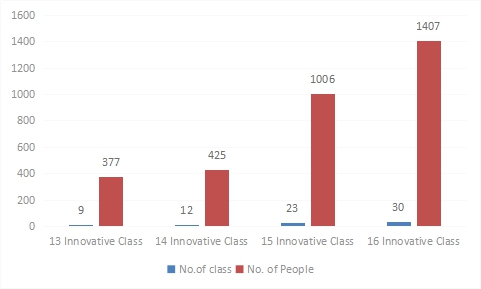
Figure 6-2 list of innovative classes and number of participants
The rate of students' evaluation of teacher of excellent is high. In the 2019-2020 academic year, the University organised students to participate in the student evaluation of teaching, in which the undergraduate students' participation rate reached 96.85%, and the teacher evaluation rate reached 95.42%. The average score of the overall teaching style evaluation of the evaluated teachers was 91.4 points, of which the excellent rate was 71.8%, the good rate was 27.3%, the qualified rate was 0.9%, and the failed evaluation rate was 0.0%. The overall excellent and good rate was 99.1%. All the evaluation results will be used in the advanced collective and individual evaluation at the end of the year to promote the continuous improvement of all departments and individuals. The results of student evaluation are shown in Figure 6-3.
Figure 6-3 Teachers’ assessment by students
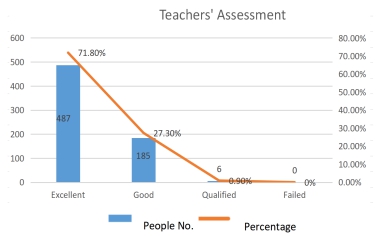
7. Students' learning effect
The University adheres to the concept of "Student-Centered", actively adapts to the needs of student's development, explores the educational concept of "OBE", reverses the design, takes advantage of the opportunity of professional certification, establishes the achievement oriented assessment mechanism, and constantly improves student enthusiasm for autonomous learning, innovative spirit and humanistic quality, and achieves fruitful results in student learning, competition, innovation and other activities.
7.1 Student's learning satisfaction
The University is committed to excellence in the investigation of student's comprehensive satisfaction, the timely discovery of issues, continuous improvement of teaching conditions and facilities, teaching process management, service management and campus culture development, so as to comprehensively improve the quality of teaching. During December 2019, the Teaching Supervision Office conducted a survey of students' satisfaction with 11 schools. The survey was conducted anonymously in the form of online questionnaire, which lasted for nearly one month. The questionnaire set 46 questions from six aspects, mainly single topic. They were teacher teaching, major and curriculum, management and service, teaching conditions, teaching style and learning, campus culture, and set two open questions at the same time. Considering the rationality of the weight distribution of individual satisfaction, the overall satisfaction survey of students to the University is set up separately. The evaluation of each satisfaction survey is divided into four options: very satisfied, satisfied, dissatisfied and very dissatisfied. In this survey, 7126 valid questionnaires were collected, covering a wide range. The data are objective and reliable. By sorting out the survey data, considering the degree of correlation with teaching and other factors, using the weighted method to calculate the proportion of students' comprehensive satisfaction is 94.23% (including very satisfied and satisfied). The satisfaction degree and weighting method in 2019 are shown in table 7-1.
Table 7-1 weighted situation of students' teaching satisfaction
Serial number |
Investigation items |
Satisfaction ratio |
Weight |
Weighted value |
1 |
Teacher teaching |
96.23% |
0.2 |
19.25% |
2 |
Major and curriculum |
92.15% |
0.15 |
13.82% |
3 |
Management and service |
89.95% |
0.05 |
4.50% |
4 |
Teaching conditions |
92.70% |
0.15 |
13.91% |
5 |
Teaching and learning environment |
93.84% |
0.1 |
9.38% |
6 |
Campus culture |
93.06% |
0.05 |
4.65% |
7 |
Overall satisfaction |
95.74% |
0.3 |
28.72% |
Comprehensive satisfaction |
94.23% |
As shown in table 7-1. The overall satisfaction rate of our students is 94.23%, which shows that our students are very satisfied with the teaching of our university and recognize the quality of our University. At the same time, it also means that 5.77% of the students are not satisfied with the teaching of our university. This shows that there is still a gap between the actual satisfaction and student psychological expectations, and the work of the University needs to be improved.
7.2 Student's learning effect
7.2.1 Students participate in various competitions
In the academic year of 2019-2020, due to the pandemic situation, student participation in all kinds of discipline competitions and scientific research projects at all levels was affected to some extent, but they also achieved very proud results. The total number of students participating in all kinds of discipline competitions at all levels has reached 378, including 118 at the national level and 260 at the provincial and ministerial level; students participated in all kinds of literary and sports competitions at all levels and won 207 awards, including 164 at the national level and 43 at the provincial and ministerial level; there are 93 students participating in 86 teacher's scientific research projects; in the academic year, 128 papers and 11 patents were published. The majority of teachers are willing to guide, and a large number of teachers have won the excellent instructor award in various competitions. Promoting teaching, research and learning by competition has achieved remarkable results.
7.2.2 Students studying for postgraduate
The University attaches great importance to the work of Postgraduate Entrance Examination. To ensure the achievement and effectiveness of postgraduate entrance examination, the University adheres to the concept of achievement-oriented, takes "creating atmosphere, leading learning environment, self-improvement and innovation, achieving excellence" as the guiding ideology, implements the working idea of "early mobilization, early goal setting and early preparation", and formulates special measures to comprehensively assist the students in Postgraduate Entrance Examination. In the academic year of 2019-2020, 508 undergraduates participated in the Postgraduate Entrance Examination, 197 of them were admitted, including many well-known universities, with an admission rate of 38.78%, exceeding the national average of 18.78%.
7.3 Graduation of undergraduates
7.3.1 Student graduation and degree awarding
There are 4462 graduates in 2020, and the graduation rate and degree granting rate are 97.85% and 97.80% respectively. Table 7-2 shows the graduation and degree awarding of undergraduate students.
Table 7-2 Degree awarding situation of undergraduate graduates in different majors
Number |
Major |
Number of graduates |
The number of students who failed to graduate on time |
Graduation rate (%) |
academic degree number of grants |
Graduate degree granting rate (%) |
1 |
Materials Science and Engineering |
26 |
1 |
96.3 |
25 |
96.15 |
2 |
Financial Management |
169 |
3 |
98.26 |
166 |
98.22 |
3 |
Vehicle Engineering |
49 |
1 |
98 |
48 |
97.96 |
4 |
Electronic Commerce |
85 |
2 |
97.7 |
83 |
97.65 |
5 |
Animation |
72 |
2 |
97.3 |
70 |
97.22 |
6 |
Clothing and Clothing Design |
133 |
6 |
95.68 |
127 |
95.49 |
7 |
Engineering Management |
44 |
1 |
97.78 |
43 |
97.73 |
8 |
Business Management |
104 |
3 |
97.2 |
101 |
97.12 |
9 |
Radio and Television Editor |
412 |
5 |
98.8 |
407 |
98.79 |
10 |
International Economy and trade |
128 |
1 |
99.22 |
127 |
99.22 |
11 |
Nursing |
192 |
1 |
99.48 |
191 |
99.48 |
12 |
Environmental Design |
326 |
11 |
96.74 |
315 |
96.63 |
13 |
Accounting |
550 |
8 |
98.57 |
542 |
98.55 |
14 |
Mechanical Engineering |
50 |
4 |
92.59 |
46 |
92 |
15 |
Mechanical Design and Manufacture and Automation |
157 |
4 |
97.52 |
153 |
97.45 |
16 |
Computer Science and Technology |
155 |
6 |
96.27 |
149 |
96.13 |
17 |
Tourism Management |
55 |
0 |
100 |
55 |
100 |
18 |
Automobile Service Engineering |
70 |
0 |
100 |
70 |
100 |
19 |
Human Resource Management |
84 |
2 |
97.67 |
82 |
97.62 |
20 |
Marketing Management |
63 |
3 |
95.45 |
60 |
95.24 |
21 |
Visual Communication Design |
393 |
9 |
97.76 |
384 |
97.71 |
22 |
Communication Engineering |
49 |
4 |
92.45 |
45 |
91.84 |
23 |
Investment Principles |
38 |
0 |
100 |
38 |
100 |
24 |
Civil Engineering |
165 |
4 |
97.63 |
161 |
97.58 |
25 |
Network Engineering |
40 |
1 |
97.56 |
39 |
97.5 |
26 |
Network and New Media |
60 |
1 |
98.36 |
59 |
98.33 |
27 |
Dancology |
30 |
1 |
96.77 |
29 |
96.67 |
28 |
Internet Engineering |
53 |
2 |
96.36 |
51 |
96.23 |
29 |
Logistics Management management |
45 |
4 |
91.84 |
41 |
91.11 |
30 |
Journalism |
81 |
0 |
100 |
81 |
100 |
31 |
Preschool Education |
213 |
1 |
99.53 |
212 |
99.53 |
32 |
Musicology |
90 |
5 |
94.74 |
85 |
94.44 |
33 |
English |
281 |
2 |
99.29 |
279 |
99.29 |
7.3.2 Employment of undergraduates
Despite the impact of the 2020 pandemic on the employment of graduates, the University leaders attached great importance to the employment work of graduates, implemented the "First Leader Project" of employment work, improved the employment guidance institutions, established the leading group and guidance center of employment work at the University and school levels, strengthened the management of employment work, established and improved the employment management system, and promoted the standardization of daily management of employment work. We have actively organised online job fairs and have done a good job in the employment of 2020 graduates, which has achieved good results. The specific distribution of graduates is shown in table 7-3.
Table 7-3 Distribution of graduate's employment
Project |
Number of people |
1.Further study (No.) |
Total |
145 |
Stay in JXUT |
0 |
To other universities |
140 |
Postgraduate without exam |
0 |
Overseas study |
5 |
2. Employment |
/ |
Total in the province |
Total outside the province |
Total |
1283 |
2155 |
Employment agreement |
Government office |
1 |
14 |
Government-affiliated institutions |
65 |
111 |
Enterprise |
1096 |
1875 |
Army |
18 |
17 |
Participating in national and local projects for employment |
23 |
33 |
other |
0 |
0 |
Further study (including further study abroad) |
64 |
81 |
Flexible employment |
0 |
0 |
Self-employed |
16 |
24 |
7.3.3 Evaluation of graduates by employers
In order to build a long-term mechanism of follow-up evaluation of graduates, the University carries out follow-up investigation of employers every year. In recent years, through interviews with employers, employers generally reflect that University graduates are "solid foundation, strong ability, high quality, able to go down, able to use and do well", and many graduates have made certain achievements in their jobs.
In the academic year of 2019-2020, the University commissioned a third-party survey agency to conduct a survey on the employers of 2020 graduates in the form of questionnaire. From the enterprise's evaluation of student's general skills, knowledge and skills, and professional quality, the overall satisfaction fully reflects the training effect of university applied students. See table 7-4 for specific employer evaluation of graduates.
7-4 Evaluation of University graduates by employers in academic year of 2019-2020
8. Characteristic development
8.1 Systematizing innovation education and initial results
According to the needs of industry and industry development, the University further defines the training goal of "high-quality applied students with expertise and certain innovation ability to meet the needs of economic and social development", vigorously promotes the reform of "2 + N + 1" applied students training mode with innovation ability, and deeply integrates innovation education into professional education, running through the process of student training, greatly improved the quality of student training.
The University has built a "Process, Four ways, Systematic" innovative education system, which has formed the characteristics of innovative education oriented by ability training. The leading group of innovative education has been set up, the school of innovation and entrepreneurship and the development center of innovative education have been set up, and the teaching and research section of innovative education have been set up, forming an orderly echelon of innovative education. The University implements the development project of "100 Innovative Classes", which covers all schools and all majors. There are 104 Innovative Classes with 4894 students, accounting for 26.79% of the total number of undergraduates.
The University devotes itself to cultivating achievements and makes remarkable achievements in innovation. The University pays attention to the support and guidance of key innovation projects, increases the cultivation of innovation achievements, and the achievements of innovation education are beginning to show results. First, the patent application has been approved with gratifying results. The University takes patent application as an important starting point for deepening innovation education and actively promotes intellectual property projects. By December 2019, 255 patents have been approved for students. In the past three years, the number of students applying for and being granted patents in our university ranks in the forefront of universities in the province, and the growth rate ranks first in the province. Second, the innovation and entrepreneurship competition has won several awards. In the past five years, students have won 4391 awards in science and technology innovation and vocational skills competitions such as "Challenge Cup" and "Creative Youth" innovation and entrepreneurship competition for college University in our nation, including 1835 national awards and 2556 provincial awards. In the national finals of the 15th "Challenge Cup" College Student's Extracurricular Academic and Technological Works Competition, a JXUT student won the first prize (only 2 students won the prize in Jiangxi Province), realizing a historic breakthrough; and a student won the second prize in the national finals of the 16th "Challenge Cup" College Student's Extracurricular Academic and Technological Works Competition.
The University firmly grasps the fundamental task of student training and focuses on cultivating student's innovation ability. For example, Luo Qi, graduate in 2000 , founded Shenzhen Haiqi Exhibition Culture Co., Ltd; Du Xinke, graduate in 2008, founded Chengli Automobile Intelligent Van Factory and Hubei Ocean Automobile Co., Ltd; Jiang Qisheng, graduate in 2009, founded Jiangxi MSQ Cosmetics Co., Ltd., with an annual output value of more than 100 million; Sang Jiandong, graduate in 2013, served as the host of Sichuan Radio and Television Station, and the producer of financial programs, became one of the founding partners of the Three Lions Venture Capital, and won the award of "China Brand 70 years, 70 people, Media Industry Innovation Person of the Year" in 2019; Miradili, graduate in 2018, founded Nanchang Abri Technology Development Co., Ltd.
The training of innovative students in the University has been affirmed and recognized by the evaluation experts of the Ministry of Education. For example, the Innovation Experimental Zone of Automobile Professional Students Training Mode and the Innovation Experimental Zone of International Economic and Trade Students Training Mode were rated as "Provincial Students Training Mode Innovation Experimental Zone". In 2015, the Education System Reform Bulletin (Issue 92) compiled and issued by the Office of the National Education System Reform Leading Group reported the experience and practice of innovation education in an article titled Jiangxi University of Technology: building the cradle of innovative students training. In 2018, the development experience of University innovation education was selected as the innovation case of connotative development of colleges and universities in Jiangxi Province during the 40 years of reform and opening-up policy.
8.2 Opening up education and moving towards internationalization
With the accelerating process of globalization, international education has become an important part of foreign exchange in many countries in recent years. Under the background of overseas strategy implemented by China Education Group, the urgency of promoting international education strategy has become increasingly prominent. According to the requirements of China Education Group, the University is prioritizing the promotion of international educational opportunities. The University is characterized by the cultivation of international students. It carries out open education, promotes international exchanges and cooperation, revises the student training plan, carries out curriculum reform, comprehensively improves student's English ability, and strives to create a new approach in the cultivation of international students.
8.2.1 Diversified university running modes
The University continues to broaden the channels and enhance the level of foreign cooperation in running University. The University has established cooperative relationship with universities in Britain, Germany and Australia and the number of cooperative universities and cooperative projects is increasing. Now we have cooperated with the University of Derby to set up "2 + 2 + 1", "3 + 1 + 1", "4 + 1" five-year student training mode for various majors. In 2017, the first international class officially opened; the University has continuously expanded the scale of international cooperation, vigorously promoted foreign cooperation in running University and learning exchanges, and made breakthroughs in the joint training of students. At present, there are more than 300 international students from 28 countries and regions such as Congo, Bangladesh and Uzbekistan. They have opened five undergraduate programs in English, and 66 teachers go to the UK to participate in learning and practice activities in summer; the University has continuously enriched the joint training mode, promoted the internationalization strategy of education, cooperated with King's Own Institute (Australia) and Richmond, The American International University in London, established eight international majors, including Financial Management, Computer Science and Technology, Computer Application Technology and Software Engineering, jointly revised the student training scheme of international major, and implanted international characteristic courses. It would benefit JXUT’s internationalization strategy to select bilingual teachers, carry out bilingual teaching, and formulate the measures for the development and management of teacher's team of international major in Jiangxi University of Technology to strengthen the assessment and management of teachers. Through the introduction of high-quality teaching resources at home and abroad, the mutual recognition of credits is gradually implemented, the classified training is implemented, and the mutual training between teachers and students is strengthened.
8.2.2 Featured international education platform
In 2020, the University established Boya International College, revised and completed the student training program of related majors of the BIC, and clarified the training objectives, ability requirements and training principles of international students. The college has launched "3 + 1 + 1", "3 + 2" and other overseas study programs, and is committed to cultivating international students with international vision, understanding international rules, adapting to international cooperation and competition, and having a sense of social responsibility. JXUT first developed a Student Training Program in BIC, and added curriculum training in practice, including Oral English, English Writing, English Listening, etc. These curriculum training programmes were carried out in different semesters in the form of case simulation training, so as to gradually improve student's daily English practice ability. Secondly, in addition to professional courses, English-related courses have been set up, such as Overview of British and American Culture, Art of Speech, Grammar, Vocabulary, Newspaper Reading, Practical Writing and so on. In addition to consolidating student's basic professional language skills, it also educates student's practical ability and comprehensive application ability, expands student's international vision, and achieves mutual assistance and support between professional skills and cultural connotation. Finally, the University combines the training objectives, based on the teaching practice, after full discussion and demonstration, carries on the reasonable processing and integration of the teaching materials, and uses the modern science and technology information technology English network resources, such as Oral English and English Listening and other related courses, selects a large number of the latest foreign language materials which can make students contact with current affairs in time. At the same time, it also encourages students to participate in relevant open courses of foreign universities through the Internet after class, so as to absorb the latest knowledge and information from abroad. These measures have laid a solid foundation for students to get ideal IELTS scores and study abroad.
8.2.3 Innovation of English curriculum reform
To improve student's English ability and promote the University’s international education strategy, Jiangxi University of Technology has formulated the plan of English Teaching Reform. To improve the student's English ability, we divide the students of the class of 2020 into three categories (art, international major and other majors), formulate the teaching plan, and make clear the College English teaching objectives, teaching contents, teaching arrangements, teaching methods, curriculum evaluation methods and teacher assessment standards. At present, the work has been mainly carried out from the two aspects of English Morning Reading Inspection and the establishment of English Innovation Class. The University has formulated the "measures for the management of student's morning reading", which has carried out an inspection on the English morning reading of the students of the class of 2020 in School of Finance and Economics, School of Information Engineering, School of Culture and Media and other schools. Focus on the students’ attendance, morning reading discipline, morning reading atmosphere to understand several aspects. All schools can carry out English morning reading according to the management measures, with good learning environment and orderly class management; the University has set up an English Innovation Class and issued the notice on setting up an English Innovation Class for undergraduates of 2020. All schools actively cooperate with the setting up work. Taking the Innovation Class as the pilot unit of reform, a total of 25 English Innovation Classes have been set up to prepare for the next step of English reform. Next, the University will adjust the student training plan to ensure the credits and hours of College English teaching, which will be implemented in the teaching plan of each semester. At the same time, it will coordinate the resources of the University to ensure the demand of College English Course Scheduling and the development of various English activities, including English competitions, English corners, English salons, etc.
8.3 Consolidating the cultivation of student's moral character and accomplish the sacred mission of moral education
Always adhere to the "Moral Education" as the main objective of education, adhere to educating people for the party and country, and educate qualified socialist builders and successors with all-round development of moral, intellectual, physical, aesthetics and labor.
8.3.1 Entrance education to lay the ideological foundation of students
In the entrance education, the theme education of "Love the Party", "Love the Country", "Love the University", "Love the Family" and "Love Yourself" should be carried out in depth. Through visiting the ideological and political base of students, the local red base for practical learning, visiting the University history museum, and special lectures on mental health education, the foundation should be further strengthened and student's ideological understanding improved. In the characteristic education of schools, student's patriotic feelings can be effectively educated and their ideological understanding can be improved by learning the basic theory of the Party, watching patriotic reports, singing red songs and watching red movies. In 2019, there were 20 lectures for entrance education, 107 studies in the ideological and political education base, and 8 studies in the revolutionary theme education base organised by freshmen representatives to achieve full coverage of entrance education.
8.3.2 The theme is bright, helping to develop noble morality
From the beginning of freshmen enrollment, the theme education activities of eight sections run through the whole college life of students. From freshmen love and law education, to sophomore honesty and responsibility education, to junior self-improvement and friendly education, to senior patriotism and dedication education. The eight themes are interrelated to form a complete moral cultivation system. Under the positive effect of the moral cultivation system, students have good basic moral quality, positive and healthy, and good moral quality and spiritual outlook.
8.3.3 Develop education and educate student's good moral character
To internalize the cultivation of student's noble morality into the cultivation of student's daily behavior. Develop and improve the Quantitative Evaluation Method of Student's Civilized Behavior Cultivation (Trial), comprehensively and objectively evaluate student's behavior cultivation performance through observation points such as classroom uncivilization, dormitory uncivilization and public place uncivilization, and strengthen student's consciousness of civilized cultivation. At the same time, through dormitory sanitation turn cleaning and other educational activities, pay attention to the education of student's daily behavior, further educate and improve the overall quality of students. At present, our students work hard, be honest and trustworthy, abide by the rules and discipline, will continue to strengthen the moral cultivation, and gradually form a good learning of "happy learning, good thinking, unity of knowledge and practice".
The University will continue to adhere to the education concept of "education oriented, moral education comes first", with morality as the main objective, theme education as the core, habit cultivation as the basis, solidly promote the ideological and political education of students, and strive to complete the sacred mission of morality.
9. Suggestions for improvement
In this academic year, the University teaching work has made encouraging achievements. However, there are still some aspects to be improved and improved, and some urgent problems to be solved in undergraduate teaching.
9.1 The insufficient application and promotion of research results in teaching
9.1.1 Main Issues
First, some teachers still have biased understanding of teaching research, and the application and practice of teaching research results in classroom teaching are less.
Second, the scope of teacher's promotion and use of the research results is relatively small, and there are still some phenomena in teaching research, such as research for the sake of research and teaching research results are shelved.
9.1.2 Cause analysis
First, insufficient understanding. Less teachers pay enough attention to teaching research, and cannot form a good atmosphere of "promoting teaching with research and promoting teaching with research".
Second, teacher's enthusiasm is not enough. Teaching research and reform has the characteristics of great difficulty, slow effect and long cycle. Some teachers are unwilling to spend too much time and energy on systematic and in-depth research and reform, and lack of lasting enthusiasm for applying teaching research results to the class and feeding back teaching.
Third, the means of achievement promotion are not enough. The popularization and use of teaching results need the joint efforts of university, schools and teachers. The University does not pay enough attention to and guide the promotion and use of teaching achievements. In addition, some teaching and research achievements are not enough in quality and application, so it is difficult for teaching achievements to be widely used in teaching reform and practice.
9.1.3 Improvement measures
First, strengthen the promotion and guidance of teaching results. Organise relevant lectures on education and teaching research, guide teachers to change their concepts of teaching and research, unify their thinking and understanding, and enhance the consciousness of all teachers to combine teaching research with teaching practice. The excellent teaching reform results will be rewarded according to the degree of promotion and application and the effect.
Second, improve the incentive mechanism of teaching reform research. University should improve the policies related to the evaluation of teacher's professional titles, and increase the weight of teaching performance and teaching reform achievements in the evaluation of teacher's professional titles and the qualifications of post appointment. We should improve the reward system for teaching research results, increase the use and reward of excellent teaching reform research results, and mobilize the initiative and enthusiasm of teachers to study teaching and actively carry out teaching reform research.
Third, strengthen the guiding role of education and teaching evaluation. Through the evaluation of teacher's basic teaching ability, we can guide new teachers to master the basic theories and methods of education and teaching. Through the evaluation of teacher's teaching level, teachers are guided to actively carry out the research of education and teaching reform. Through the evaluation of the working status of teaching units, we can guide each teaching unit to establish and improve the interactive mechanism of teaching and scientific research.
9.2 Application-oriented teaching ability needed to be improved
9.2.1 Main performance
First, the integration of information technology and teaching is not enough. In the process of teaching, some teachers simply use PPT to show the teaching content, and they pay less attention to the cultivation of student's ability.
Second, the teaching ability of some new teachers needs to be improved. The training of applied students puts forward higher requirements for teachers, and some new teachers cannot reasonably arrange the teaching content according to the professional characteristics and the training requirements of applied students.
Third, the ability of classroom teaching organisation needs to be improved. Some teachers regard students as passive knowledge receivers, student's learning initiative and enthusiasm cannot be fully developed, and student's energy in class is not concentrated, such as dozing, playing mobile phones and so on.
9.2.2 Cause analysis
First, some young teachers are lack of teaching experience and weak in classroom management and control, so it is difficult to use appropriate teaching methods and means to mobilize the class learning environment and improve the learning effect according to the teaching content and individual differences of students.
Second, the task of teaching and scientific research is heavy and the work pressure is high. Some teachers are reluctant to invest more energy and time in the reform of teaching methods, and cannot reasonably update and improve teaching methods.
Third, some teachers are lack of professional practical experience, it is difficult to arrange the teaching content according to the needs of applied students training, and there is less interaction and practice with students.
9.2.3 Improvement measures
First, strengthen the training of teachers. Strengthen the one-to-one support system and mentoring system, and regularly carry out teaching observation, teaching competition and other activities to improve teacher's teaching level. To promote teacher's professional development and teaching ability, we should build a platform for teacher's teaching experience exchange, and build a long-term mechanism of passing on, helping and leading the old to the new.
Second, improve the teaching evaluation mechanism. Teachers are encouraged to update teaching contents and methods in time, strengthen interaction between teachers and students, and mobilize student's enthusiasm and initiative in learning. Through the student's evaluation, supervision and timely feedback, peer timely help and other ways to promote the level of teaching.
Third, deepen the development of teacher's ethics. Through ideological education, institutional norms, policy incentives, typical guidance and other ways to enhance teacher's professional quality, enhance teacher's sense of responsibility and mission of teaching and educating people. Combine the education of teacher's ethics with the improvement of teacher's professional skills to promote the reform of teaching.
9.3 Timelines for the implementation of improvement measures